I am still catching up on processing and sharing thoughts and impressions from our visit to the United States last summer. One episode I was anxious to share involved an activity I have very rarely engaged in: going to church.
I am far more familiar with synagogues, having been raised jewish, but I have occasionally attended church services, and not just for funerals and weddings. I like observing ritual and find organised religion, even as I don't believe in such institutions, endlessly fascinating. My eldest shares this interest, so it seemed a very natural thing to ask if they wanted to attend a Sunday service and hear their grandmother sing in the choir. They were willing, if not enthusiastic, so we woke up early and went.
It was the funniest service of any denomination I have ever attended.
Now, I don't think the rest of the congregation shared my amusement, but it was all I could do not to laugh my head off. As said, our motivation in attending the was to hear my mother-in-law sing. She's the only regular church goer in the family, and we knew our show of support would be much appreciated. What we didn't account for were the idiosyncrasies of the other choir members. Their numbers were thinned over the course of the pandemic, and several of the remaining choristers were sick that day. Only two members and the director were there to sing. That's ok. Then the "music" began.
Instantly, I found myself transported to the Netherfield Ball. Mary Bennet, in all her glory, was at her instrument. The choir director, who I understand to be a very dear woman, is the only one with a microphone, which sits before the piano, and she sings and plays both loudly and horribly. I never heard a note out of my mother-in-law's mouth. The resemblance to the 1995 version ofPride and Prejudice, in which Lucy Briers captures Mary Bennet so perfectly, was remarkable:
I'm sitting there, a bit of a stranger in a strange land, itching to share the joke with someone, anyone. My child has fully and totally rejected Austen, and I knew they would only scoff at me if I whispered the source of my mirth. So I sat, grinned, and bore it, trying to control myself. The service lasted an hour, and I was about to applaud myself for not being abominably rude, when they began the hymn "Let all Things now Living," which I had never heard before, but the tune I totally recognized: the old Welsh folk song "The Ash Grove." This is the song that Elizabeth Garvie as Elizabeth Bennet plays at the Lucas' in the 1980 version of Pride and Prejudice. I thought I would die of laughter. Fortunately, I had a handkerchief with me, and smothered the noise. I know not what the people behind me thought. Perhaps they assumed I was having some religiously ecstatic fit.
As soon as we got back to the house, I made everyone watch the following clip. Garvie made an excellent Elizabeth, and David Rintoul, I have always felt, looks more like my image of Mr. Darcy than any of the other actors who have taken on the role (read my review of the film here). Enjoy, and please laugh with me.
We did not get to do much sightseeing while visiting the US this summer. After three years away, we were almost entirely focused on just spending time with family. This makes me kind of sad because my children are unfamiliar with so many places I took for granted growing up, especially being from Philadelphia, so seeped in US history. I was pleased we squeezed in a trip to Baltimore Harbor, also an old stomping grounds of mine, and toured the USS Constellation. The other excursion we managed, as mentioned in my last post, was in Kentucky, to Pleasant Hill and the Shaker Village preserved there. It was interesting being back after so many years, and I feel like my memories of this most recent visit represent, in many ways, a microcosm of the overall trip. I'm going to attempt to put that sensation into words.
I must first and foremost note that the visitor experience to Shaker Village has altered greatly since I was first there in 2008. The tours are now almost entirely self-guided, a COVID Era innovation, I assume, with the aid of an app. I always find it a little disconcerting utilising such technology in historic preservation locals, but such is our world.
There are still live presentations by the staff, and the quality of the two I enjoyed remained excellent. One was a repeat of my favorite "adventure" on my prior visit: Shaker Music in the Meetinghouse. This was led by a different woman than last time, but I was equally impressed with the mighty voices of both, beautifully demonstrating the fabulous acoustics of the room. There were not many attendees on a rainy Tuesday morning (this was the week of this summer's Kentucky floods), only ourselves and two other people. The leader was great, incorporating my restless four year old into a demonstration of a children's dance, and providing a lot of fun facts I did not previously know, like anecdotal evidence that the Shakers could be heard seven miles away, where their stomps sounded like gunshots (to view a reenactment of a Shaker meeting, please see my previous post), and stories of just how disruptive the Shakers were in merry old England before immigrating to the American colonies shortly before the Revolutionary War.
Readers of Austen should have great appreciation for stories of Mother Anne Lee, considered their messiah by members of the United Society of Believers in Christ's Second Appearing, which is the proper name for those now commonly known as Shakers. Imagine a very orderly Church of England Sunday service, the likes of which any of the many clergymen in Austen's novels might have led, being invaded by Mother Anne and her followers, determined to disrupt and shout over the proceedings to their best ability. Can't you just see Mr. Collins' befuddlement and Lady Catherine's outrage? I had to laugh.
These anecdotes aside, what most impressed me was how the speaker, a Black woman, handled a very uncomfortable moment with one of the other attendees. The person had asked how the Shakers handled slavery, a very reasonable question. A cautious but rehearsed reply was provided, detailing the mixed legacy of the Shakers on this subject, who were implicitly anti-slavery but nevertheless participated in the local, slave-owning economy. The community had lots of seasonal visitors, perhaps particularly during the Civil War. Some of these needed food and shelter, but others were contemplating joining the Shakers. This required giving up all your personal possessions to the community, who freed all slaves acquired in this manner. The questioner replied: "Oh, that's a real hardship."
I think my jaw dropped. I was prepared for the atmosphere in the United States to have changed (it was already well on its way) over the course of the pandemic and following the reinvigoration of the Black Lives Matters movement due to the horrifying deaths of Ahmaud Arbery, Breonna Taylor, George Floyd, and way, way too many others. And yes, I grew up in a progressive bubble, but I have rarely in my life heard anyone indulge in such blatant racism, particularly in a public venue. Racist expressions, when I did encounter them, were whispered in low voices, because the speaker knew they were shameful. Not that it really makes it any better, but they weren't voiced loudly, in a room with booming acoustics, nor directly addressed to a person who would obviously feel the sting of the words. I spent many years debating political correctness, rightly calling out that it just hid the harm and didn't address it, but I guess it did at least it provided some standard of decent conduct.
My shock aside, what really hit me was how often the presenter must have heard something just like it. She paused but a moment, presumably choking down the hurt, and proceeded on with her delivery. I followed her lead, and bit down my urge to call the person out. It was surely the pragmatic and safest way to respond. But what does that do to a person to have to live with such normalized, casual wounds? I felt these tensions in smaller, less dramatic ways throughout the trip. I read the political signs throughout the country with both hope and horror. I felt the pain of the attacks on my own non-binary kid, in anti-LGBTQ+ billboards and t-shirts, and pride in displays of inclusivity and acceptance. There is a real fight for human liberties underway, and I have to celebrate that, because I want to live in a world where everyone is treated with the respect and dignity they deserve, but the reaction scares me, as is intended.
Though I laughed at her tactics, Mother Anne was amazingly brave.
Later that morning, as we sat down for lunch at the village restaurant, featuring food sourced form their own organic farm (another great tour, if hot in summer), I filled my kids' and mother-in-;aw's ears with my repressed anger and indignation. After summarily denouncing the questioner and having a good, indignant rant, I concluded with the thought, "I bet she's sitting right behind me, isn't she?" I turned around, and sure enough, there she was. What can you do but laugh?
Note: this is a repost from my "purged" materials, originally appearing on another blog in early October 2015, shortly before that year's JASNA AGM. I share it again now having recently revisited Pleasant Hill. I will share my updated impressions next week. Please enjoy.
Aerial view of Pleasant Hill
‘Tis the gift to be simple, ’tis the gift to be free
Tis the gift to come down where we ought to be,
And when we find ourselves in the place just right,
‘Twill be in the valley of love and delight.
When true simplicity is gained,
To bow and to bend we shan’t be ashamed,
To turn, turn will be our delight,
Till by turning, turning we come ’round right.
– Words and Lyrics by Elder Joseph Brackett, 1848
Ooooh I’m suffering from major AGM envy! Several of my fellow Austen Authors are gathered in Louisville, KY right now for the JASNA Annual General Meeting, and it absolutely pains me to not be there, especially as I have a great attachment to Louisville, where my husband went to school and my in-laws live. But my place in the world is now Switzerland, which truly is a “valley of love and delight.” So I may not be able to partake of the festivities: c’est la vie! What I can do is share a little bit of my knowledge and experiences of my absolutely favorite 19th century historical site in Kentucky: the Shaker Village at Pleasant Hill.
We receive little hint in Austen of the evangelical and revivalist movements of the 19th century. Mary Bennet is mocked for her religious austerity, but that is about as close as we come. However, the late 18th and early 19th centuries were a boom time for dissenters, or those who interpreted christianity in a manner differing from the Church of England. Unsurprisingly, many persecuted believers found their way to the United States, where they hoped for more religious freedom.
Amazing stairway designed by Micajah Burnett
One of the new sects was the Shakers, or The United Society of Believers in Christ’s Second Appearing, a group that splintered from the larger Quaker movement. Led by “Mother” Ann Lee, whom the group believed to be the second manifestation of Christ, a small group of believers left England for the New World in May of 1774. Ironically, they were imprisoned upon arrival for six months due to their refusal to take an oath of allegiance. Nevertheless, this was the beginning of what became a powerful utopian movement, at its height in the mid-19th century having many thousands of adherents living the Shaker lifestyle in a bevy of communities across the northeast and mid-west.
There are a few (like four) Shakers still living in their community at Sabbathday Lake Shaker Village in Maine, but the groups fierce belief in abstinence prevented it from ever becoming mainstream. Shaker men and women, who were considered completely equal within the community and divided all leadership roles, lived in separated communal houses. All property was shared. Everyone worked in the self-supporting communities, as the act of labor was considered a path to god. I’ve always wondered how much abstinence fueled the amazing creations the Shakers produced (need to channel that energy somewhere), for they were incredibly innovative, inventing such things as the first washing machine. The Village at Pleasant Hill is an architectural marvel. Brother Micajah Burnett, who joined the group with his parents at the age of 17, was a self-taught architect who designed the main buildings in the village, using innovative techniques to create large, open spaces, minimizing obstructive beams and supports. The buildings are in amazing condition all these years later. The acoustics in the Meetinghouse he designed are phenomenal. As Shaker worship involves ecstatic singing and dancing, the entire room must have erupted with their voices, clapping, and stomping. Above the main floor of the Meetinghouse was the housing for the village elders: two women and two men.
Attic of the Meetinghouse designed by Micajah Burnett
When I visited Pleasant HiIl we were taken into the attic of the Meetinghouse to see the impressive beams and supports. It is architecturally astounding, but also very dusty. My allergies becoming unbearable while our tour guide spoke, I excused myself and returned, alone, to the living quarters for the elders. The walls were decorated with photographs of Shakers over the years, and I was diligently studying these when something bumped into me, swinging my purse around so that it collided with my chest. I spun around to see who it was, but there was no one there. Keep in mind that while the living quarters are separated into rooms, it is still a very minimalistic space. There were no walls, pillars, or furnishing anywhere near me. I am not one to have otherworldly experiences – this is the only one I can claim – but the absolute sense of peace that filled me when this encounter occurred was truly one of the most thrilling moments of my life. Whatever or whoever it was, the experience filed me with an unshakable (ha ha) belief that the adherents of this way of life truly did create something heavenly on Earth. To visit the Shaker village is, in someways, to become a believer.
The Shakers were pacifists, like the Quakers, and were the first religious group to receive an exemption form military service during the Civil War. Though they were anti-slavery, they tended to both Union and Confederate forces who found their way to the communities. There were many African-American members, who were considered and treated as true equals in a time when even the staunchest abolitionists tended to believe in white superiority. As the members did not have children (unless the family joined as a unit), foundlings and orphans provided population stability. At age 21, members could choose to stay or remain. Most chose to leave, for no matter how prosperous and harmonious life was in the Shaker Villages, abstinence always has and will be a hard sell.
Simple and open interior of the Meetinghouse
I named this post after one of my favorite songs in the world: the Shaker hymnal Simple Gifts. Perhaps the lasting contribution of the Shakers is their music. The below video was filmed many years ago in the Meetinghosue at Pleasant Hill and recreates a Shaker call to worship and service. It is fascinating, but there is one aspect that is not very authentic (other than the fact that Mother Ann never made it to Kentucky), namely the singing. As Shakers believed that god gave everyone a distinct voice, they did not believe in harmonizing their songs. Everyone sang in whatever key was natural to them. The performers in this video are a chorus, and they use elaborate arrangement and harmonization to make it sound good. A real Shaker meeting would be far more cacophonous, but this is probably more pleasant to listen to. Please enjoy, and if any of you AGMers have the opportunity while in Kentucky to visit the Shaker Village, I highly recommend it! There is even a hotel there now so you can stay in the village, and it is only 80 miles outside of Louisville.
"If you had been a week later at Lisbon, last spring, Frederick, you would have been asked to give a passage to Lady Mary Grierson and her daughters."
"Should I? I am glad I was not a week later then."
The Admiral abused him for his want of gallantry. He defended himself; though professing that he would never willingly admit any ladies on board a ship of his, excepting for a ball, or a visit, which a few hours might comprehend.
"But, if I know myself," said he, "this is from no want of gallantry towards them. It is rather from feeling how impossible it is, with all one's efforts, and all one's sacrifices, to make the accommodations on board such as women ought to have. There can be no want of gallantry, Admiral, in rating the claims of women to every personal comfort high, and this is what I do. I hate to hear of women on board, or to see them on board; and no ship under my command shall ever convey a family of ladies anywhere, if I can help it."
This brought his sister upon him.
"Oh! Frederick! But I cannot believe it of you. --All idle refinement! --Women may be as comfortable on board, as in the best house in England. I believe I have lived as much on board as most women, and I know nothing superior to the accommodations of a man-of-war. I declare I have not a comfort or an indulgence about me, even at Kellynch Hall," (with a kind bow to Anne), "beyond what I always had in most of the ships I have lived in; and they have been five altogether." - Persuasion
USS Constellation, Baltimore Harbor, Maryland
We had an adventure! After three years away, my family spent a month in the United States this summer. It was a whirlwind trip, despite its length, and while we got to see an enormous number of relations (I've counted 95), I am still recovering a week after our return. One of our side jaunts was to Baltimore Harbor, an old stomping ground, where we toured the USS Constellation, a sloop-of-war built in 1854. Yes, this is a US ship, and yes, it is more modern than the ships Captain Wentworth and Admiral Croft would have captained, but it gave me a wonderful notion of what life at sea might have been like in the early 19th century (the Constellation was the last sail-only warship crafted by the US Navy). The conversations about life at sea held at Uppercross weighed on my mind as I drifted between the decks. Could Mrs. Croft be so comfortable as she declares onboard? Is Wentworth simple misogynistic, or might the presence of women and children be legitimately challenging?
Captain's Quarters, facing the stern
Captain's Quarters, facing the bow
Captain's Berth
I always admired Mrs. Croft's spirit, and while similarly non-fussy ladies might indeed make the most of life at sea, I imagine many more would find the circumstances trying. The captain's quarters, which film and story suggest would be ceded to traveling ladies, are reasonably spacious. Located in the aft of the gun deck, a large and inviting dining/conference area has small rooms along each side, which include a bedroom, a washroom, an office, a pantry, and a guest berth. Lady Mary Grierson and daughters, however many they number, would surely have filled the space to capacity. They might have a great deal of privacy and comfort, unless the ship suddenly saw action. Those 18 cannons right outside this oasis surely made a terrifying racket, even without considering the larger ramifications and possible consequences to their being manned. And where would this leave a displaced captain? Down a deck in the berth, where everyone else slept. Here each officer and the doctor had their own small closet for quarters, while everyone else slept in hammocks hung from the ceiling. The Constellation could house up to 265 enlisted men and 21 officers (the modern tour does not attempt to replicate what this must have smelled like).
Captain's Study
Even with their sleeping quarters on different decks, your typical english lady traveling on a warship would be thrust into very close proximity to exactly the kind of man (i.e. ungentlemanly, with all that term's classist trappings) from which their entire upbringings had been designed to shield them. Discipline in the Navy was strict, and Lady Mary would have had little to fear for her daughters' vaunted "purity," but the experience would have to be educational, to say the least.
Is this "idle refinement?" I'm not sure. Note that Mrs. Croft is childless and makes no claims regarding the presence of a larger family onboard (just touring the ship with two kids was a challenge). And what of women who did not have the gentility to be deemed "ladies?" I doubt anything but the most extraordinary of circumstances would land one aboard. Should such a thing occur, perhaps a gallant captain would still provide her with those protections granted to a female of higher class, otherwise she would be in for a harrowing experience, indeed, and perhaps would have even preferred to remain marooned on an island, or wherever she came from, than endure it.
These dark musings aside, I highly recommend a visit to the USS Constellation, if possible. It has definitely given me a hunger for more old ships. I'm not sure the kids feel the same way, but I'd love to go to Portsmouth, walk in Fanny Price's footsteps, and visit Nelson's HMS Victory. It's on my bucket list. If I ever make, I will surely regale readers with an account of the experience here.
And of Baltimore is not one of your upcoming destinations, or if you just want more information about the Constellation, go ahead and check out the virtual tour: https://historicships.org/explore/uss-constellation. There are also interactive images of each deck to explore. Enjoy!
I was in Florence last week. Firenze ... you've changed, but you're still the same. I couldn't visit in the manor I'd truly wished, being subject to the whims and needs of a family party (we were together for the first time since the pandemic began!), but I did indulge myself by rereading A Room with a View while there and with some truly wonderful shopping.
Florence has such amazing stores. It was by accident that I stumbled into my favorite discovery of the trip. It says something unsettling about me that I was more thrilled by finding the ugliest bonnet it has ever been my absolute pleasure to behold than by the treasures of the Uffizi, combed over the day before, but what a cappellino!
The store is called Antiquariato il Cancello and is located in the Via dei Fossi, 13/r (www.antiquariatoilcancello.com). It is a tiny place packed to the brim with vintage pieces and, amongst them, some truly historical finds. Something perverse in me prevented my taking pictures, but the particular bonnet in question was so tattered already that I could not bear to subject it to anything more. I suspect it ought to be in a museum collection (if any conservators are in the position to rescue it, you'll find it just inside the shop entrance on your left).
It might be later than I suspect, Italian fashion not being my specialty, but my gut tells me it is an 1820-30 creation. It is a mourning bonnet with a good amount of embellishment, all sadly decaying, and of a poke style that I particularly dislike, close fitting and seeming to reach around the wearer's face like a collar, a la Hannah More above. I have been scouring the internet trying to find an image of something that does it justice with little luck. Instead, I ask the reader to use their imagination:
Cross this bonnet,
with these,
then trim it up like this,
and now give it to a ghost to wear for a century or two.
It was dreadful. Dreadfully magnificent. I do hope someone finds it the right home.
Other treasure stumbled upon include some beautiful parasols and a few late 19th century gowns, but the bonnet brought tears to my eyes. Oh, the things it's seen! Boggles the mind and sparks the imagination.
We just returned from what has become an annual ski vacation. I even skied this time, for the first time, I believe, since 1985. It went ... ok I guess? I'm even considering trying it again next year, but this time I must insist on a proper instructor, not my husband and daughter.
We were at the same resort two years ago, when COVID was just hitting the news. Having had a lifelong fear of epidemics/pandemics, it had already on my radar for five or six weeks in February 2020, especially when Jack got sick with flu-like symptoms that trip. We were there again last year, masked but unvaccinated. So it felt like we were coming full circle this year, when the Swiss government lifted the vast bulk of regulations on the 17th. The hospitality workers were quite giddy, though still only cautiously hopeful that the end of this pandemic really might be approaching. Everyone is so tired and traumatised. I do so hope that we all find the time to heal.
That simmering optimism was at odds with my reading material (to say nothing of the news cycle, which I did pay some modicum of attention to). I hadn't read any E.M. Forster in a good many years and sort of thoughtlessly threw a copy of Where Angels Fear to Tread in my bag. I was curious to reread an old favorite author, to see how my perspective on his works might have changed with both social progress and age. It is his novel that I had read longest ago and only once, when I was still in high school, and I did not recall much about it. It just so happens to also be his first novel, and I am feeling some temptation to continue through his work chronologically, if I can find the time.
Such an endeavor really should be accompanied by a survey of modern literary criticism of his work. I really am not sure what current scholars have to say of him. His glaring imperialism can be incredibly disturbing. It seems amazingly unconscious on his part, his presumption of British supremacy is so thickly woven into his plots. At the same time, his voice is vitally important as one of the very few gay voices represented in the English literary canon, and those same plots, infuriating in their arrogance, tell heartbreaking tales of isolation, fractured identity, and the torture conventional society can inflict on those forced to adhere to its strictures. At the climax of Where Angels Fear to Tread, I threw the book from me and ferociously paced the room, weeping hysterically. The pain was so, so raw. How did I not recall it? I must have been far too young to understand what I was reading.
My grand takeaway was a violent warning against overly managing parents, more concerned with reputation than their children's well-being.
Austen also addresses these themes, in the horrors of Eliza William's fate in Sense and Sensibility and Sir Thomas' hubris in Mansfield Park. Such potential simmers in characters like General Tilney of Northanger Abbey, Lady Catherine of Pride and Prejudice, and Lady Russell of Persuasion.
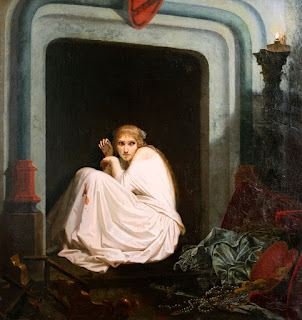
Folie de la fiancée de Lammermoor, Émile Signol, 1850.
The darkness of the text and its imperialist perspective notwithstanding, the story somehow still manages to include absolutely brilliant comical moments, most accessible to me in the clash between English and Italian cultures. There is one scene in particular, where three English travellers in Italy go to the opera, that perfectly resemble real exchanges I have witnessed in my travels. His depiction brought particularly to mind a visit to the Arena di Verona in 1999 to see Aida, where the large contingency of Germans in the audience took exception to the more raucous behavior of the Italian attendees (the latter were adept at perfectly ignoring the former). In the book, the performance is Lucia di Lammermore. I've always wanted to see this, as The Bride of Lammermoor, upon which it is based, is my favorite Sir Walter Scott novel (in keeping with my well-established penchant for books about insanity). Perhaps that contributes to my delight in this moment:
Harriet, meanwhile, had been coughing ominously at the drop-scene, which presently rose on the grounds of Ravenswood, and the chorus of Scotch retainers burst into cry. The audience accompanied with tappings and drummings, swaying in the melody like corn in the wind. Harriet, though she did not care for music, knew how to listen to it. She uttered an acid “Shish!”
“Shut it,” whispered her brother.
“We must make a stand from the beginning. They’re talking.”
“It is tiresome,” murmured Miss Abbott; “but perhaps it isn’t for us to interfere.”
Harriet shook her head and shished again. The people were quiet, not because it is wrong to talk during a chorus, but because it is natural to be civil to a visitor. For a little time she kept the whole house in order, and could smile at her brother complacently.
Her success annoyed him. He had grasped the principle of opera in Italy—it aims not at illusion but at entertainment—and he did not want this great evening-party to turn into a prayer-meeting. But soon the boxes began to fill, and Harriet’s power was over. Families greeted each other across the auditorium. People in the pit hailed their brothers and sons in the chorus, and told them how well they were singing. When Lucia appeared by the fountain there was loud applause, and cries of “Welcome to Monteriano!”
One can almost feel sorry for Harriet (but not really).
These were the literary musings that entertained me while on holiday. I wish I had been able to read more. We are supposed to go to Florence this spring ... A Room with a View might prove irresistible in its temptations.
I had better hurry up and find those modern essays on Forster. Any suggestions?
The following was originally posted in August 2019, pre-pandemic, after returning from our last trip to the US. I maintain some hope of getting there this year, but it's fading. Yes, it was a hard trip, but I had no idea it would be the last for two years, and I wish we had taken more time. The meaning of the title quote continues to deepen.
Gabriel Joseph de Froment, Baron de Castille, and his wife, Princess Hermine Aline Dorothée de Rohan, with their family. French School, 1825.
I’ve long loved travel. It’s a passion my parents sort of had to force on me, but once it took hold, I was hooked. Journeys, even short ones, have a remarkable ability to change your perceptions, even of those things most familiar and dear. I had a startling reminder of this while traveling with my family in the US for two weeks. Though we took the baby to visit family when he was four months old, I consider this our first proper overseas excursion with two children, and oh my! What a marathon we ran! It was a lot of work, but I was prepared for it, and I think we weathered it pretty well. I returned home ready to process the memories, and as always I looked to Austen for guidance. What a shock to discover that this holiday suddenly allowed me to relate to Lady Middleton! My interpretation of Austen has again undergone a metamorphosis, driven by the new set of experiences and impressions brought on by travel with kids.
Take the title quote as an example. In the oh so recent past, I celebrated it for its snark, usually invoking it after saying goodbye to houseguests. Suddenly, it imparts a coziness before unknown. In Indiana, we had two nights at the house of my in-laws, a four bedroom which slept close to twenty people over the course of our stay. Now that was a party! Then in Texas, on the banks of Lake LBJ, my aunt and uncle’s four bedroom housed over ten for two nights. It was wonderful being with so many cousins and loved ones, but covering five states in fifteen days kept each reunion short and succinct. Normally, I might have lamented this brevity, but with the two kids it was just right. My daughter wasn’t around anyone long enough to become too provocative, and the toddler (he’s a good little monkey, but very curious) didn’t have long enough to figure out how to cause any true chaos. He did attempt to abscond with all my aunt’s remote controls, but I thankfully checked the bag he stashed them in before departing.
When I now read the quote, which references a visit by Isabella and John Knightley to Hartfield, I can barely trace the sarcasm I once found in it. Yes, our travels were perfect in being much too short. We left pleased with everyone and them with us. Just another day or two to linger might have soiled my happy recollections. It was incredibly hard to say goodbye, too soon and for too long, over and over again, but boy, did we feel the love! How fortunate we are to have such a wonderful and diverse family! I’m so grateful my children got to know them all better. Living so far away makes the time together so much more precious.
On every formal visit a child ought to be of the party, by way of provision for discourse. In the present case it took up ten minutes to determine whether the boy were most like his father or mother, and in what particular he resembled either, for of course every body differed, and every body was astonished at the opinion of the others. – Sense and Sensibility, Chapter Six
Another favorite quote that is suddenly imbued with new resonance. I’ve felt its truth for a long time, as my daughter has for eight years provided living proof, but my little guy is much more sociable and engaging than she was, content to sit sit and immerse herself in a project. Jack likes to be in the middle of everything. It is actually rather a strain on conversations, as they are hard to maintain, but he certainly keeps things from ever getting dull.
Unfortunately, a baby can’t be charming all the time, and I was honestly too tired to protest whenever someone volunteered to chase after him for me, a scenario which allows me to empathize with Lady Middleton’s hitherto intolerable laxity.
She saw with maternal complacency all the impertinent encroachments and mischievous tricks to which her cousins submitted. She saw their sashes untied, their hair pulled about their ears, their work-bags searched, and their knives and scissors stolen away, and felt no doubt of its being a reciprocal enjoyment. It suggested no other surprise than that Elinor and Marianne should sit so composedly by, without claiming a share in what was passing.
“John is in such spirits today!” said she, on his taking Miss Steeles’s pocket handkerchief, and throwing it out of window–“He is full of monkey tricks.”
And soon afterwards, on the second boy’s violently pinching one of the same lady’s fingers, she fondly observed, “How playful William is!”
“And here is my sweet little Annamaria,” she added, tenderly caressing a little girl of three years old, who had not made a noise for the last two minutes; “And she is always so gentle and quiet–Never was there such a quiet little thing!”
But unfortunately in bestowing these embraces, a pin in her ladyship’s head dress slightly scratching the child’s neck, produced from this pattern of gentleness such violent screams, as could hardly be outdone by any creature professedly noisy. – Sense and Sensibility, Chapter Twenty-One
Almost without exception, repeatedly over the course of the trip, anytime I asserted something about one fo the kids, their behavior instantly contradicted me. What can you do but laugh? It’s an inescapable part of motherhood. And let’s be honest: sometimes mom is just too tired to get up and stop the tormenting child. It doesn’t make it right, but it’s true. My apologies to anyone who was screamed at, bitten, or hit during the course of our travels. Poor Lady Middleton! What a relief it must be to her to have the Misses Steeles to stay and distract the children. I’m actually feeling a bit salty with Austen here, as she is quite hard on Lady Middleton, who really isn’t a bad sort. Wow! There’s a revolution for my mind.
The journey would have been totally intolerable if not for the help of my husband. I don’t know how my mom managed me on her own, a thought which led me to reevaluate my opinion of Anne Elliot and Captain Wentworth’s relationship. Persuasion has long been my favorite Austen novel, but my feelings towards Wentworth are subject to rather massive revision about once a decade (Anne I shall ever hold in the utmost and unwavering esteem). When I first read the novel, my heart was all Wentworth’s. In more recent years, I’ve found him rather petty and immature, though his letter always wins my forgiveness in the end. I still think he’s awfully childish in his behavior towards Anne upon their first reacquaintance, but the years have taught me that some men, like my husband, will always retain a certain immaturity (really wouldn’t have him any other way, though it’s challenging at times), and that the best relationships involve give and take, and a perception of the other’s needs to make that work. This is what the captain so perfectly displays when he and Anne are thrust together one morning at Uppercross Cottage. It is a scenario that I have lived innumerable times over the past few weeks.
Another minute brought another addition. The younger boy, a remarkable stout, forward child, of two years old, having got the door opened for him by some one without, made his determined appearance among them, and went straight to the sofa to see what was going on, and put in his claim to anything good that might be giving away.
There being nothing to eat, he could only have some play; and as his aunt would not let him tease his sick brother, he began to fasten himself upon her, as she knelt, in such a way that, busy as she was about Charles, she could not shake him off. She spoke to him, ordered, entreated, and insisted in vain. Once she did contrive to push him away, but the boy had the greater pleasure in getting upon her back again directly.
“Walter,” said she, “get down this moment. You are extremely troublesome. I am very angry with you.”
“Walter,” cried Charles Hayter, “why do you not do as you are bid? Do not you hear your aunt speak? Come to me, Walter, come to cousin Charles.”
But not a bit did Walter stir.
In another moment, however, she found herself in the state of being released from him; some one was taking him from her, though he had bent down her head so much, that his little sturdy hands were unfastened from around her neck, and he was resolutely borne away, before she knew that Captain Wentworth had done it. – Persuasion, Chapter Nine
He might be angry and hurt, but Wentworth must act, must do what he can to help, when he sees that Anne requires it. My husband has a similar, easy way of stepping in just when I need him to, usually while others sit nearby and admonish the problem child from afar, a la Charles Hayter. I think it is in this moment that the captain first proves his ongoing worthiness of Anne’s affections. I hope I let my husband know how much those moments mean to me.
Tinted line drawing by C.E. Brock, courtesy of Mollands.net.
On the other side of the coin, there were moments during our travels when my husband stood there and stared at me when I most required assistance, usually after Jack fell and hurt himself (this happened at least three times a day). In one particularly striking incident, the baby fell down a flight of steps, luckily coming to a halt on a landing instead of making the rest of his way down to the bottemmom. I was there in an instant, scooping him up, and turned to see both my mother and husband staring at me in shock. What would I not give to have had an Anne Elliot on the scene? Fortunately, he was largely unscathed, but as the near disaster swarmed around me, my mind managed to drift away to Lime Regis:
“Is there no one to help me?” were the first words which burst from Captain Wentworth, in a tone of despair, and as if all his own strength were gone.
“Go to him, go to him,” cried Anne, “for heaven’s sake go to him. I can support her myself. Leave me, and go to him. Rub her hands, rub her temples; here are salts; take them, take them.” – Persuasion, Chapter Twelve
I always wanted to be more like Anne, but not to the extent of being the only deer that knows how to run from the headlights. That was quite frustrating. However, it was Captain Wentworth’s cry for help that first leapt into my mind, allowing me to relate to his predicament a great deal more than I have in recent years. “Are you all just going to stand there and stare at me?” I cried. “Someone get ice!” I guess I should just count my blessings that there is a pseudo-Anne on hand, and that we’re not both befuddled in an emergency. This goes back to the give and take. We all have our strengths to bring to the team. I bet Anne and Wentowrth made a great one.
So travel, as always, has expanded my mind, and consequently my understanding of my favorite writer. This process will continue throughout my life, and who knows where it will lead me? How has your perception of Austen changed with the years?
More recycled content, but still a favorite post of mine. I wrote the following in January 2017, hence the recent travel references. Enjoy.
Illustration by Thomas Rowlandson, 1806.
"What a charming amusement for young people this is, Mr. Darcy! -- There is nothing like dancing after all. -- I consider it as one of the first refinements of polished societies."
"Certainly, Sir; -- and it has the advantage also of being in vogue amongst the less polished societies of the world. -- Every savage can dance."
Mr. Darcy's snide retort to the oblivious Sir William Lucas might have had a different resonance with Austen's contemporaries than it does with modern readers. I always read it in the past with racial overtones, and I think a lot of modern scholars put a post-colonial interpretation on it. The word "savage" undeniably has its colonial implications, yet it is possible Mr. Darcy refers not to the indigenous people of distant continents, but rather to Europe's very own German and Austrian peasantry, spinning about scandalously wrapped in each other's arms. You see, when Pride and Prejudice was published in 1813, Regency society was just being hit with the dance revolution called the waltz. This infiltration from the continent was considered just as libidinous in its time as the pelvic thrusts of Elvis Presley were in his, maybe even more so. Society seems to have had three main objections to the waltz: it required very little training (always dangerously egalitarian), the "closed hold" brought the bodies of dancers together into a heretofore unheard of degree of intimacy, and it eliminated the passing of one's partner to another, keeping a couple anti-socially focused on only each other throughout a set. Jane Austen herself probably never danced a true waltz, being thirty-six and a confirmed spinster when the dance finally made its official debut at Almacks in 1812. Nevertheless, many Austenesque fiction writers can't resist the urge to portray our heroes and heroines engaged in a waltz. We're in good company, as neither can Disney. Admittedly, one can't quite float on air through the steps of a country line dance (nor maintain a solid conversation), but I'm not sure that's enough to explain the unique grasp the waltz has on our imaginations. It takes a very special dance to hold humanity entranced for hundreds of years, and it's ubiquity shows no signs of abating.
I was so fortunate as to spend New Year's Day at the stunningly beautiful Schloss Schönbrunn, the former summer residence of the Hapsburg imperial family. It is hard to visit without having your thoughts turned to the waltz. Walking through the Great Gallery one can vividly imagine the dancers at countless balls across the centuries, twirling about in fabulous gowns and frock coats (they do not allow photography at the Schloss, but you can enjoy an excellent virtual tour of all the rooms open to the public at the Schönbrunn website). This is where the waltz as we know it was born, amidst the dazzling splendor of 18th century Vienna, but its ancestry is far more humble. The Waltzer, a dance for two persons, first developed around the mid-18th century amongst the alpine peasantry in Germany and Austria. At the same, time the Ländler, another couples dance, became popular with peasants across the Alps, from Switzerland to Slovenia (see it performed in The Sound of Music above). Aristocrats, for generations constrained to performing intricate and controlled dances like the minuet and allemande, seem to have developed something like envy for the freedom allowed their underlings, and the gentleman are said to have snuck off to the parties of their servants in order to indulge in the new fad. Eventually a new form of allemande developed in Vienna, backed by the likes of Mozart, melding the traditional court dance with that of the peasantry. The dance had always been characterized by intricate arm formations and hand grasps with one's partner. Now the close hold was introduced. A few more refinements from the dance masters - less stamping, more gliding - and the waltz was well on its way to arguably being the biggest dance craze of all time. By the beginning of the 19th century, everyone in Europe was waltzing except the Brits.
The Napoleonic Wars are certainly much to blame for delaying the waltz's arrival in London, but society in England was also more conservative than that on the Continent. Dances such as the Duke of Kent's Waltz (see it performed above) were popular at the turn of the century, but these received their names from the act of spinning with one's partner in a tight circle and did not incorporate the closed hold. It wasn't until after the Regency officially began that the waltz had its shocking debut. That first waltz at Almack's was still very different from the forms codified a few decades later, possibly resembling the new form of allemande more than anything else. A version of this survives as a traditional folk dance and can provide some notion of what it might have looked like. Compare the video of it below to that of a baroque allemande to get an idea of how the peasant's Waltzer and ländler influenced the dances of the European royal courts.
Whatever it looked like (we will probably never know for certain), the scandal was very real. Even the infamous Lord Byron, no prude by any means, was appalled by the dance and wrote a poem expressing his horror entitled The Waltz in 1813, the same year the world was introduced to Lizzy and Darcy. Here is an excerpt just to give you an idea of how overtly sexual Byron considered the dance:
But ye—who never felt a single thought For what our morals are to be, or ought; Who wisely wish the charms you view to reap, Say—would you make those beauties quite so cheap? Hot from the hands promiscuously applied, Round the slight waist, or down the glowing side, Where were the rapture then to clasp the form From this lewd grasp and lawless contact warm? At once love’s most endearing thought resign, To press the hand so press’d by none but thine; To gaze upon that eye which never met Another’s ardent look without regret; Approach the lip which all, without restraint, Come near enough—if not to touch—to taint; If such thou lovest—love her then no more, Or give—like her—caresses to a score; Her mind with these is gone, and with it go The little left behind it to bestow.
1815 print by Henry Meyer after G. Williams, courtesy of The British Museum.
The sanctity of feminine virtue aside, the waltz was in England to stay. The politicos and socialites who flocked to the Congress of Vienna in 1814 and 1815 came home fully enrapt. The danced received the highest sanction in July of 1816, to great uproar. First came the announcement on the 11th of the publication of dance master Thomas Wilson's A Description of the Correct Method of Waltzing, the Truly Fashionable Species of Dancing (which you can view in its entirety here). This codification of the dance for polite society must have been all the Regent was waiting for, as a mere three days later he held a ball at which the waltz was said to be danced for the first time by the royal court (The London Times, 16 July, 1816). Below see an instructional video for the version of the dance as described by Wilson (skip to the very end to watch the steps danced in succession).
For decades to come, the waltz would continue to be condemned for its crudeness and sexuality. Even Queen Victoria's firm advocacy would not completely silence detractors. Would we like the waltz so much if it had? For we cannot deny, even from our jaded, modern perspectives, that the waltz is sexy. It always has been and always will be, even in a world where twerking is de rigueur. Maybe especially in a world with twerking. What would Mr. Darcy say?
Let's end with one last video, this one filmed at Schönbrunn, both in front of the palace and in the Great Gallery. It's a beautiful demonstration of the art and elegance with which this once rustic dance was eventually imbued. The music is the Kaiser Waltz by the waltz master himself, Johann Strauss, and features a ballet interpretation of the music as well as Viennese waltzers. The lead ballerinas are in the guises of Emperor Franz Joseph I and Empress Elisabeth (better known as Sisi), who ruled the Austrian Empire for most of the 19th century.
For more information on the history of the waltz in England, please read Cheryl A. Wilson's excellent essay, The Arrival of the Waltz in England, 1812, to which this piece owes a great debt. I also relied on this post which provides a broader overview of the history of the waltz.
I am not hugely enamored with military history, but one cannot study Jane Austen's era without knowing something of Nelson. For better or worse, my early impressions of the man were defined by the 1941 film That Hamilton Woman (it's amazing how many characters, both real and fictional, were first introduced to me as Laurence Olivier). Those of us who don't find military history fascinating sometimes cling to scandalous tidbits like Nelson's affair with Emma Hamilton, as they are far more engaging to our brains than battle maneuvers. So it was with some chagrin that I visited The Nelson Monument on top of Calton Hill only to discover the small but highly informative museum exhibit dedicated to him there made not a single mention of his notorious mistress. For my five pounds, I would have liked to have had that small bone tossed my way. Of course, I was paying to climb the tower and enjoy the view, which I would gladly do again.
I suppose the legitimate Nelson enthusiast must get rather bored of we dilettantes who want to delve again and again into the details of his great romance. I understand that his military career is legendary and of far greater lasting significance than the details of his love life. Yet when presenting the image of a man in his entirety - when seeking to understand his character and motivations - is not such information essential? Behold his portrait on display at the National Portrait Gallery in London: this is not the image of a glorified military emblem (as we saw George IV portray himself in the same room), but a surprisingly gentle and unassuming looking man, not formidable in the least despite the proudly display of his Star and Ribbon of the Bath and Naval Gold Medal. This portrait is based on one from a previous sitting for the same artist, though it was also taken from life, and it was commissioned for Lady Nelson. How I wished there were portraits of both she and Lady Hamilton nearby! Perhaps such a display would be a bit sensationalist, especially in a room of the gallery dedicated George IV, but I would have reveled in it, nonetheless. I find this portrait fascinating in its backstory. There is some madness in this tale, and that always sparks my imagination. This is from the NPG website:
Although Nelson only sat to him twice, Abbott subsequently copied the picture over forty times. The copies gradually declined in quality as the artist became mentally ill but this was no bar to their popularity. Many were purchased by Nelson's naval colleagues, his family and friends.
In July 1798, Nelson's wife wrote to him: 'My dearest Husband - I am now writing opposite to your portrait, the likeness is great. I am well-satisfied with Abbott… it is my companion, my sincere friend in your absence…'.
Nelson supposedly began his affair with Lady Hamilton that September, so there's your scandal. Revel with me.
Please enjoy the views from the top of the monument. It was incredibly windy up there but totally worth the climb. One gets the feeling of being an admiral on his ship, looking out into the endless distance. https://creativecommons.org/licenses/by-nc-nd/3.0/legalcode
The Nelson Monument, Calton Hill, Edinburgh
View of Hollyrood Castle from top of Nelson Monument
View of the rest of Calton Hill from Nelson Monument, including the National Monument of Scotland and the City Observatory.
View of Arthur's Seat from Nelson Monument
View of Calton Hill, Edinburgh New Town, and the Firth of Forth, estuary to the North Sea, from Nelson Monument.
It's been a long time! Too long. I am now a year into to my expat life in Switzerland. My daughter has started kindergarten, and suddenly I can find time to blog once more! Yeah! I'm not sure what my frequency will be for a time - I'm trying to finish writing all the books I abandoned a year and a half ago - but I have to start somewhere.
That somewhere is Scotland. I'm off to Edinburgh tomorrow to reunite with dear family and have an all around excellent time. I haven't been there since I was fourteen, an age at which I did not yet see Austen associations everywhere, but my adult self feels the need to mark my journey with a discussion of the infamous Gretna Green marriages over the anvil, which three of Austen's novels utilize as a plot device.
"We were within a few hours of eloping together for Scotland. The treachery, or the folly, of my cousin's maid betrayed us. I was banished to the house of a relation far distant, and she was allowed no liberty, no society, no amusement, till my father's point was gained." - Colonel Brandon, Sense & Sensibility
"I am going to Gretna Green, and if you cannot guess with who, I shall think you a simpleton, for there is but one man in the world I love, and he is an angel." - Lydia Bennet, Pride & Prejudice
Why Gretna? Anywhere in Scotland might do, and several other border towns were well known for performing runaway marriages. The Marriage Act of 1753, aimed at curtailing underage marriages and those without parental consent, declared that the banns (an official wedding announcement) be read on three Sundays during Sunday services in the home parishes of both bride and groom. This gave anyone objecting to the marriage an opportunity to stop it. Faster marriages could take place by special license, but if the bride or groom were under twenty-one they required parental consent. So what's your Regency Era Romeo and Juliet supposed to do? Make a run for the border, of course.
"You may not have heard of the last blow--Julia's elopement; she is gone to Scotland with Yates." Lady Bertram, Mansfield Park
It was called marriage over the anvil because Scottish wedding ceremonies did not have to be performed by a clergyman, and often the first person available to perform a ceremony would be the blacksmith, stationed in proximity to the coaching inn. Only two witnesses were required to make the marriage legal. The practice continued unabated until 1856, when Scottish law was changed to require a twenty-one day residency before a ceremony could take place.
Gretna remains a popular wedding destination, and tourists flock to the old smithy to touch the historic anvil, which is supposed to convey luck in love. I won't make it there this trip, but it would be delightful to visit someday, perhaps renew some marriage vows. An elopement to Scotland sounds romantic, but as countless Regency heroines have learned the hard way, it really wasn't all it was cracked up to be. Still, the aura of romance persists, and I feel the lure.
"... Sophia and I experienced the satisfaction of seeing them depart for Gretna-Green, which they chose for the celebration of their Nuptials, in preference to any other place although it was at a considerable distance from Macdonald-Hall." - Laura, Love and Friendship