Thursday, March 31, 2011

Rifts and Restorations: Margaret Dashwood's Story by Sister M. Eucharista Ward

I came across Rifts and Restorations: Margaret Dashwood's Story by Sister M. Eucharista Ward accidentally on Amazon when searching for a different novel, and immediately purchased it to read for the Sense and Sensibility Bicentenary Challenge hosted by Austenprose. I really loved A Match for Mary Bennet and was ecstatic to find another Austen continuation by this author. Unfortunately, while entertaining, this book did not live up to its predecessor. It begins several years after the conclusion of Sense and Sensibility, when Margaret Dashwood is still unmarried at age twenty-seven. Much of it is told in flashbacks, retelling the events of Margaret's romantic life, interspersed with the details of her sisters' lives, particularly Elinor's. So much happens in less than 300 pages that it is almost impossibly to summarize succinctly, but here are the major points: Lucy Ferrars is a Machiavellian nuisance, Mrs. Ferrars a fickle tyrant, and Margaret must learn to cope with her disgust for both with grace, a lesson that corresponds to her finding true love.

While the multitude of events that make up this story contribute to the difficulty in reviewing it, the biggest impediment is the lack of coherence in the character development. While this is a problem across the board, I think I can best illustrate it by examining the very first line, "A young lady of meager dowry deemed in her youth to be 'not promising,' shows great indiscretion in refusing a suitor of substantial means." Nothing at all about the depiction of Margaret Dashwood conforms to this notion of her being "not promising". From a young age she stops eligible gentlemen in their tracks with her beauty, and while she does reject at least one proposal from a man of "substantial means", the gentleman who is referred to in this opening sentence may have means, but they are in no way substantial. In fact, his status as an agent of Willoughby's, caring for the house at Allenham (which the charming rogue did indeed, after all, inherit) in the owner's absence, is one of dependence, though it is depicted in a highly glorified manner. His eventual marriage to the daughter of a shopkeeper is far more appropriate than a union with a gentleman's daughter. Stranger still is the fact that the lady he does marry is somehow accepted without question by society, though she too is without the benefit of a dowry. The entire book is filled with these confusing discrepancies, requiring the reader to suspend thoughtful analysis in order not to become frustrated.

My other issue with the book is the religious content. I suppose I should not be surprised by it, considering the author is a nun, as well as the fact that A Match for Mary Bennet was highly religious, but I was more easily able to over look it in the case of that novel due to the main character's established spirituality. The problem here is that not only is religion presented far more overtly than it is in Austen, but also it is of a decidedly Catholic nature, which feels very much out of sync with an early 19th century English setting. Now I'm married to a Catholic, and I have absolutely no issue with Catholic literature, but it just doesn't work with Austen. The book would have been vastly improved if Ms. Ward had suppressed the urge to inject her own religious beliefs into the story and kept such references within the scope of Austen's purview. The fact that the novel also covers content of a decidedly unsavory nature makes the injection of religion all the more jarring.

All this being said, I did find the book enjoyable. I like the notion of exploring Margaret's story and found her depiction compelling. I just think that the book would have been far more effective if significantly cut and cropped and edited for historical accuracy. Perhaps if I had never read and adored A Match for Mary Bennet, freeing myself from having to contend with disappointed expectations in Rifts and Restorations, I would have found the novel more satisfying.
 

Tuesday, March 29, 2011

"...in proportion to their family and income": Jane Austen's Houses in Life and Fiction - presentation by Iris Lutz to JASNA of Eastern Pennsylvania

Steventon Rectory as portrayed by Anna Lefroy
Last Saturday I attended the spring meeting of JASNA of Eastern Pennsylvania with my husband (one of the benefits of pregnancy - he's my constant companion!). It is only the second meeting I have been able to attend since I joined, and, unfortunately, it looks likely to be the last one I will make it to this year. I have regretted not being able to take advantage of more of the lectures and house tours planned, but my schedule has refused to accommodate them. The enjoyment of Saturday's meeting only makes me regret my poor attendance all the more. We gathered at the Joseph Ambler Inn, just a bit North of where I grew up, and enjoyed an excellent meal before the presentation by Iris Lutz, our new JASNA president. Ms. Lutz informed us we were her guinea pigs - the first to view the presentation before she takes it to several JASNA branches across North America - and those who will enjoy her discussion after this fall will have the added benefit of all the new images she intends to bring home from the Jane Austen tour of England she is taking this summer. Nevertheless, I found the whole very informative and thought provoking. The slide show began with a very useful chart, breaking down the houses in Austen's stories into two categories by age: those that were the oldest (Northanger, Norland, Allenham, Southerton, Donwell, Highbury Vicarage, Uppercross, and Winthop) and those that were contemporary (Barton Cottage, Rosings, Mansfield, Hartfield, Kellynch Lodge, and Mr. Parker's house in Sanditon, Trafalger House). Obviously, the list isn't all inclusive (where oh where is Pemberley?), but I just had to jot it down as a handy reference for keeping architectural styles straight in my mind. Ms. Lutz then proceeded to discuss the houses Austen both knew and imagined, beginning with the smallest and working her way to the grandest. I want to provide you with a brief synopsis of her points, as much of the information was not only informative, but it also had the effect of triggering my ever-present wanderlust, which I have absolutely no hope of indulging anytime in the near future.
Ashe House

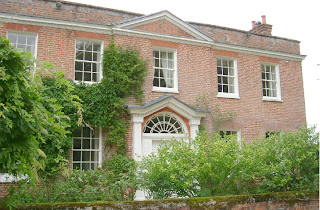
She began with rectories, sharing the famous image Anna Lefroy drew of the Austen home at Steventon (pictured above). Speaking of Austen's tomboyish childhood games, which always conjures up images, for me at least, from the beginning of Northanger Abbey and Catherine Morland's similar activities, it was a touching tribute to this lost monument to our favorite authoress. Pictures of the still standing medieval church, where Mr. Austen preached for so may years, were reassuring in this context. I was particularly excited by Ms. Lutz's attention to a nearly thousand year old yew tree that grows in front of the church, in which the rectory key was hidden by the Austens, and where Jane certainly enjoyed the shade. In order to give us a concrete vision of a rectory, Ms. Lutz then turned to the nearby Ashe House, where the Lefroy family lived. Regarding this mid-sized, Georgian home, she cited one scholar's (missed the name!) notion that it could have resembled Austen's vision of Longbourn or Hartfield, a notion I have grave doubts about, particularly regarding the latter, but perhaps the style of home can give us a image upon which to base our ideas of these domains. I like to think it is more along the lines of Henry Tilney's home at Woodston.

Chawton Cottage
Ms. Lutz proceeded to discuss to cottages, a part of the presentation I found particularly compelling. She began, logically, with Chawton, which was built in the 1600's and, as it was originally an inn, presents a hodgepodge of architectural styles. Those of us who have never been so fortunate to visit this sacred place can at least take solace in the notion that it is well protected until the time when we can make the pilgrimage. She showed us a variety of images from her visit there, but what I found most interesting were the references to Sense and Sensibility that abounded in this part of Ms. Lutz's presentation. Including a picture of the cottage next door to Chawton as a starting point, which, complete with thatched roof, far more conforms to our modern notions of cottages, she turned to Austen's depiction of Barton Cottage: "As a house, Barton Cottage, though small, was comfortable and compact; but as a cottage it was defective, for the building was regular, the roof was tiled, the window shutters were not painted green, nor were the walls covered with honeysuckles." Making the point that the house used for Barton in the 1995 version of Sense and Sensibility better conforms to this description than the one used in the 2008 production, which is far more picturesque, I could not help but wish she had also included a recitation of the passage in which Robert Ferrars describes his notion of a cottage:
Barton Cottage in the 2008 version of Sense and Sensibility
"Some people imagine that there can be no accommodations, no space in a cottage; but this is all a mistake. I was last month at my friend Elliott's, near Dartford. Lady Elliott wished to give a dance. 'But how can it be done?' said she; 'my dear Ferrars, do tell me how it is to be managed. There is not a room in this cottage that will hold ten couple, and where can the supper be?' I immediately saw that there could be no difficulty in it, so I said, 'My dear Lady Elliott, do not be uneasy. The dining parlour will admit eighteen couple with ease; card-tables may be placed in the drawing-room; the library may be open for tea and other refreshments; and let the supper be set out in the saloon.' Lady Elliott was delighted with the thought. We measured the dining-room, and found it would hold exactly eighteen couple, and the affair was arranged precisely after my plan. So that, in fact, you see, if people do but know how to set about it, every comfort may be as well enjoyed in a cottage as in the most spacious dwelling."
Ibthorpe House

This even far grander notion of a cottage, which the ever practical Elinor dismisses as not deserving "the compliment of rational opposition", might be ridiculous, but it does emphasis how our modern perceptions of such structures are entirely influenced by the picturesque rather than reality.

Ms. Lutz next turned to small manor homes, particularly Ibthorpe House, where Mary and Martha Lloyd grew up. Though not large, it is a handsome Georgian property. This house was also suggested as a model for either Longbourn and Hartfield, and while I still maintain that Hartfield would be on a grander scale, I can envision it as a Longbourn, or possibly even a Delaford.

Chawton House
We then moved on to stately homes, commencing with images of Chawton Manor House, which is an old structure, built in the late 1500's. It is an example of Jacobian architecture, and I found it interesting when Ms. Lutz revealed that it had been covered in white stucco during Austen's life, giving it a very different appearance than as pictured to the left. Austen would, of course, have been intimately familiar with this structure, and I can see it being used as a model for the houses in many of her later novels, particularly Sotherton Court or Dowell Abbey. Ms. Lutz made a great argument for the former residence being modeled off of Stoneleigh Abbey, which Jane visited in 1806, upon leaving Bath, as her mother's cousin, Thomas Leigh, had just inherited it. The timing is certainly provocative, and many of this Elizabethan structure's features conform to the description of Sotherton. Landscaped by Repton, who left a previously standing wilderness (!) untouched, the quantities of gilding and mahogany make a compelling case (we listened to the passage containing the "shining floors, solid mahogany, rich damask, marble, gilding, and carving" description). The crux of the case for this being the home that Austen had in mind when she described Sotherton is the chapel which, though not by any means lacking in grandeur (just Gothic influences), does in many ways fit Austen's depiction:
Stoneleigh Abbey
Having visited many more rooms than could be supposed to be of any other use than to contribute to the window-tax, and find employment for housemaids, "Now," said Mrs. Rushworth, "we are coming to the chapel, which properly we ought to enter from above, and look down upon; but as we are quite among friends, I will take you in this way, if you will excuse me."


They entered. Fanny's imagination had prepared her for something grander than a mere spacious, oblong room, fitted up for the purpose of devotion: with nothing more striking or more solemn than the profusion of mahogany, and the crimson velvet cushions appearing over the ledge of the family gallery above.
The Chapel in Stoneleigh Abbey
This is a point that the guides at Stoneleigh apparently dwell on at length, and while the family pews do contain crimson velvet cushion and are accessible from above (unfortunately you can't see that in the image to the right), the room certainly does not appear oblong, but rectangular, and I question whether the pews being mahogany qualifies as a "profusion". Still, it is an exciting theory, and the building undoubtedly has a huge number of windows. Overall, I found this to be one of the most powerful parts of the presentation. I would love to visit this place, for all of the above mentioned reasons but also, more particularly, to view the phenomenally gorgeous library, which houses the Leigh family history.

Goodnestone Park

Next Ms. Lutz quickly discussed Goodnestone Park, family home of Elizabeth Austen Knight nee Bridges, which far more confirms to my notion of Hartfield, or perhaps even Rosings, as the location in Kent and the presence of a church right beyond the park tempts me to believe (it certainly appeared lavish enough). We then turned to the all important Godmersham Park, Edward Austen Knight's main residence, to which Jane was a frequent visitor. Ms. Lutz proposes this as the model for Pemberley, though I, despite never having been there, always thought of it more like Mansfield Park. It's a Palladian style home built in 1782, and the best argument for it being Pemberley is premised upon the approach, the improvement of which Edward oversaw, which concurs with Austen's depiction:
Godmersham Park
They gradually ascended for half a mile, and then found themselves at the top of a considerable eminence, where the wood ceased, and the eye was instantly caught by Pemberley House, situated on the opposite side of a valley, into which the road, with some abruptness, wound. It was a large, handsome, stone building, standing well on rising ground, and backed by a ridge of high woody hills; -- and in front, a stream of some natural importance was swelled into greater, but without any artificial appearance. Its banks were neither formal, nor falsely adorned. Elizabeth was delighted.
While I agree that the approach could be a viable argument for this being Pemberley, I cannot help but question the theory. I think I just consider Pemberley a fairytale place and cavil at any attempt to tie it to reality. I certainly agree with Ms. Lutz that it is highly unlikely Austen premised the house on Chatsworth, no matter how tempting the grandiose dimensions of that place. She put forth the often argued point that the Duke of Devonshire had an income of 100,000 pounds a year, placing his home well beyond the range of what Mr. Darcy could reasonably afford.

Winchester Cathedral
Ms. Lutz then presented an overview of Bath and where in that town Austen and her characters lived. It was an interesting summary but difficult to represent here. She ended with images of the West College Street residence in Winchester where Austen died and the cathedral where she is buried. I found the entire afternoon perfectly lovely. Often I wander through my neighborhood, imagining this or that house as a model for the homes depicted in Austen's novels, and Ms. Lutz's exploration of this subject added fuel to my musings. Perhaps someday I will do a post displaying pictures of these homes which have so captivated my imagination. Better yet, maybe I will eventually have my own snapshots of the homes Austen knew so well to share! I know I'll manage an Austen tour eventually, and I can only hope it happens sooner rather than later.

Images:
Steventon -http://addictedtojaneausten.blogspot.com/2008/09/steventon-jane-austens-real-true-home.html
Ashe House -http://janeaustentour.com/locations
Chawton -http://www.jasna.org/info/about_austen.html
Barton - http://thesecretunderstandingofthehearts.blogspot.com/2011/02/sense-sensibility-bicentenary.html 
Ibthorpe House -http://www.jasna.org/tours/tour2008.html
Chawton House - http://www.jasna.org/news_events/ivp.html
Stoneleigh Abbey -http://en.wikipedia.org/wiki/File:Stoneleigh_abbey_27j08.JPG
Chapel at Stoneleigh - http://www.stoneleighabbey.org/westwingandchapel.html
Goodnestone Park - http://www.jasna.org/tours/tour2009.html
Godmersham Park - http://janeaustensworld.wordpress.com/2009/10/07/edward-austen-knight-a-tightwad-or-a-man-with-heavy-responsibilities/
Winchester Cathedral - http://www.planetware.com/picture/winchester-cathedral-eng-gb075.htm

Friday, March 25, 2011

Gestational Diabetes and Jane Austen

So today should be a Janeicillin day, and while I am anxious to explore all the ins and outs of Eleanor's romance, my head just isn't in it. I found out this morning that I have gestational diabetes, in spite of the fact that I have always been a healthy weight, exercise regularly (obsessively some would say), and eat precisely the way I am supposed to. Frankly, I am in shock, on top of being terrified of all the possible repercussions. While I have every intention of doing precisely as the doctor directs, and the knowledge that I know several people who were similarly diagnosed and have perfectly healthy children is reassuring, the notion of glucose testing is causing me to panic. I have always been terrible about any kind of blood letting, no matter how minute, ever since I accidentally got into my Dad's lithium when I was three and had to have my blood monitored for two days (they can't pump your stomach in such a case as lithium goes directly to your blood stream). I never had a blood test since that I wasn't sedated for, until pregnancy prevented me from relying on such methods. I do feel like I've gotten pretty good at keeping myself calm through the myriads of tests that they give you when pregnant, but having to do the testing myself is a whole different story. I need to find a way to brace myself for this, so that I can prick my finger multiple times a day without fainting, and of course I turn to Jane Austen for assistance.

Quite frankly, any medical treatment, no matter how irrationally afraid I might be of it, pales in comparison to what Jane Austen had to endure at the end of her life. It is not my intention today to recount the many different posthumous diagnoses out there, but just to focus on the spirit and bravery that allowed Miss Austen to face her painful decline and eventual death. I should be rejoicing in the blessings of modern medicine, a science that can pinpoint the amount of insulin my body is producing and compensate for it, rather than sitting here crying over a silly little pin prick. It is my hope that by putting my situation in this perspective, I can scold myself into rationality.

Several of my recent readings have been stark reminders of the blessings of modern medicine. Last week I reviewed Dearest Cousin Jane by Jill Pitkeathley (read the post here), a book that emphasizes the astounding serenity with which both Jane's cousin Eliza and her mother, Philly, faced breast cancer, suggesting that their behavior inspired Austen when she too was confronted with illness. And just yesterday I reviewed David M. Shapard's The Annotated Persuasion (read that post here), focusing in on the character of Nurse Rooke and the lack of resources available to those in pain and medical need at the time. All this makes me reflect upon Sanditon and the remarkable humor which or dear authoress was able to display regarding medicine while on her death bed, in particular her depiction of the hypochondriac Parker sisters, Diana and Susan. A line in a letter from Diana, describing Susan's recent treatments, particularly comes to mind:
She has been suffering much from the headache, and six leeches a day for ten days together relieved her so little that we thought it right to change our measures, - and being convinced on examination that much of the evil lay in her gum, I persuaded her to attack the disorder there. She has accordingly had three teeth drawn, and is decidedly better, but her nerves are a good deal deranged.
And the notion of glucose testing sends me into a panic! What I weakling I am! Instead of succumbing to all this fear, I will do my best to count my blessings. I will give birth in a sanitary environment, with no concerns for the "childbed fever" that used to kill so many (including Edward Austen-Knight's wife, Elizabeth). If the gestational diabetes does cause the baby to grow too big and a cesarean proves necessary, there is virtually no risk of complication (during the Regency is was basically a death sentence). I have great doctors who thoroughly understand this complication and will treat it accordingly, minimizing the risks it poses. So much to be thankful for! If dear Jane were here, she certainly would mock my worries. Keeping her in mind will hopefully keep me rational. Perhaps Janeicillin (the name of which itself feels taunting at the moment) will help!

Thursday, March 24, 2011

The Annotated Persuasion, Edited by David M. Shapard

I absolutely adored David M. Shapard's annotated Pride and Prejudice, and so when I learned that he had come out with an annotated Persuasion, I was quick to purchase a copy. Unfortunately, in order to devote to it the time I wanted to, it took me a while to get around to reading it, let alone, once I commenced, finishing it. Reading an annotated edition is not like sitting down with a novel and consuming it, cover to cover, in my normal manner. It is more like studying a text in a class, with all the supplementary information that accompanies such a setting. Mr. Shapard's books are laid out so that Austen's text is on the left side of a page, with all his notes and observations listed on the right. This makes the information easily accessible, but as it also lends itself to skipping ahead to examine an illustration of a carriage, or consult a map, as well as flipping back to reread a prior note that touches on the same subject, the speed at which you read is extraordinarily slow. The effort is worth it, as even for someone like me, who has read these novels countless times, new and different ways of perceiving and thinking about the text emerge. The only downside is that, unlike in a class, when I disagree with something Mr. Shapard asserts, there is no one on hand to debate the point with me.

Mr. Shapard beautifully illuminates certain points in the text that I had not previously considered in such a light, furthering my understanding of the manners and customs of the Regency Era. For example, regarding the character of Nurse Rooke, he provides information that I did not formerly have about the role nurses played in this society. When she is first introduced into the narrative ("[Mrs. Smith] had been particularly fortunate in her nurse, as a siter of her landlady, a nurse by profession") he notes:
The term "profession" applied to nurses at the time only in a very loose sense, for there was no regular training or certification for nurses, let alone any kind of organization. Most nursing was done at home, by family members and servants, as seen earlier in the cases of little Charles Musgrove and Louisa. Among those who earned a living as nurses, some worked in the small number of hospitals existing at the time; a much larger number worked as private nurses like the person mentioned here. In either case, a nurse had a status similar to that of a servant and performed cleaning as well as strictly nursing tasks. This nurse's periodic unemployment and need to live with her sister indicate the precarious nature of her position.

While neither the lack of an organized nursing profession, nor the status held by nurses, was surprising to me (having read the works of Florence Nightingale), I had not previously thought about Nurse Rooke's dependence on her sister for a home before. This becomes more interesting later, when Mrs. Smith makes the following comments about Nurse Rooke's perspective during her revelations about Mr. Elliot:
... I do not think nurse in her heart is a very strenuous opposer of Sir Walter's making a second match. She must be allowed to be a favourer of matrimony, you know, and (since self will intrude) who can say that she may not have some flying vision of sttending the next Lady Elliot, through Mrs. Wallis's recommendation?
On this occasion Mr. Shapard notes:
Nurse Rooke would naturally favor matrimony - which at that time almost always involved at least the attempt to have children - from a wish for more opportunities to work as a monthly nurse for women giving birth. She would be especially likely to find such employment from affluent women, as any wife of Sir Walter would be. In a letter Jane Austen shows the importance of recommendations when she writes of someone getting a nurse who, though with "no particular charm either of person or manner," is pronounced by local people "to be the best nurse that ever was" (NO. 17, 1798).
Now here is an "ah ha" moment. I had never before paused to consider the above words of Mrs. Smith's in any detail, considering that they are slipped in amidst such dramatic and pivotal disclosures as those she makes in this scene. Suddenly Nurse Rooke's motivations have meaning beyond idle gossip, and the additional information regarding Austen's letters not only provides an excellent example of the kind of supplementary information Mr. Shapard incorporates, but also sheds light on an earlier note regarding Nurse Rooke, gossip, and recommendations. Returning to the scene in which we first meet Mrs. Smith and, subsequently, Nurse Rooke is introduced, Mr. Shapard writes:
Nurse Rooke's frequent sharing of interesting gossip may be another sign of her shrewdness and intelligence. It would be a useful service for a nurse to perform for a confined patient, one that might raise the patient's spirit - at a time when physical means of curing ailments were very limited - and that would enhance the value of the nurse's services, making te patient more likely to retain her and recommend her to others.
All together, the reader forms a far more in depth picture of this very minor character than would otherwise be attained. I offer up this very minor example of how Mr. Shapard's notes enhance the reading experience as it so well illustrated how easy it becomes to flip forward and back through the book, turning 500 pages into a far lengthier read. I can also use it to attest to what I believe is the failing of any endeavor of this sort, which I admit is not one I can reasonably hold Mr. Shapard responsible for, and that is my unquenchable desire for yet more information than can be reasonably provided. In this same scene, Anne makes a long statement regarding the unique opportunities "woman of that class ... if they be intelligent" have for making observations about humanity. This passage has long struck me as unique in Austen, providing the most detailed commentary she ever makes upon the serving class (and perhaps even expressing a bit of envy for it?), and Mr. Shapard lets it pass by without any relevant commentary. My complaints about this edition almost all center around similar moments when I just want more than Mr. Shapard, in all his exhaustiveness, supplies.

While I do not consider these annotated editions appropriate for a first time reader of Austen's novels, as the notes often reference events to come and episodes from her other novels, they are perfect for those of us who read and reread her books year after year. Furthermore, if you are a writer of JAFF, they are nearly invaluable resources, as the maps provided and, especially, the detailed chronologies of events are excellent sources of reference. When I wrote First Impressions, I kept a copy of Mr. Shapard's Pride and Prejudice with me all the time, and the ragged condition of this tomb attests to how often I turned to it. While reading his edition of Persuasion, I found inspiration for a "What if?" rewrite based upon this, my favorite Austen novel, a notion I have often considered but never found a satisfying way of pursuing. Unfortunately, this effort will have to wait until I complete my current projects, but I look forward to ravaging this book to the same degree that I did its predecessor. In the meantime, I am all anticipation for the release of his annotated Sense and Sensibility, due out on May 3rd, in perfect time to celebrate the book's bicentenary.  

Tuesday, March 22, 2011

The Rice Portrait Mystery

Jane Odiwe, artist and author of Lydia Bennet's Story, Willoughby's Return, and Mr. Darcy's Secret, has been at the forefront of unraveling a real life Austenesque mystery. The subject is the controversial "Rice Portrait" of Jane Austen, long believed by some to be the best (by far) portrait of the writer ever painted. The authenticity of the painting's subject has been a matter of dispute for generations. If it is Jane, it is the answer to many a fan's dreams, portraying her in all the youthful beauty we would like to attribute to the beloved author, but verification has never occurred. The argument for the portrait is compelling: the Rice family are direct descendants of Edward Austen Knight, Jane's wealthy brother, and the painting has been in the family since shortly after its execution. Despite familial testimonials, which have long held it to be an image of Jane, doubts about the painting have centered upon the lack of written mention of it from contemporary sources and questions about the period appropriateness of the sitter's dress. However, Ms. Odiwe has been presenting new and exciting evidence that makes the case that the portrait is indeed Jane and, perhaps even more thrilling to me, revealing a new painting that might very well be an even earlier image of the writer, portrayed with her family as a very young girl. I was ecstatic to be asked to share this information with you, and I urge everyone to follow Ms. Odiwe's blog (http://janeaustensequels.blogspot.com) as she reveals more and more pieces to this fascinating puzzle.


The first aspect in this new argument for authenticity is premised upon identifying Ozias Humphrey, portrait painter and miniaturist, as an established painter of the Austen family. Ms. Odiwe provides a brief biography of the artist in her first post in this series, which you can read here. Humphrey most certainly painted a portrait of Austen's great-uncle, Francis Austen of Sevenoaks, the man who paid for George Austen's (Jane's father) education and presented him with his second living at Deane, and Henry Austen is recorded commenting upon the painting. Furthermore, it is believed that Jane and Casandra were visiting Francis at the time when the Rice Portrait was commissioned. Humphrey's work can be identified by an unusual insignia he included in his paintings: an O with an H crossed through its middle. Ms. Odiwe's second post (read it here) focuses on identifying this mark in a series of Austen family portraits, starting with the verified image of Edward Austen Knight upon the occasion of his Grand Tour in 1788. First establishing a compelling argument that this portrait was not painted in Rome, as has been asserted, but in England, she goes on to identify Humphrey's signature hidden in the texture of the tree upon which Edward leans (an English oak). This brings us to the contentious portrait of Jane, also believed to be executed in 1788, in which she identifies not just one, but three potential monograms: in the tree, by her shoe, and in the locket around her neck.

Humphrey's establishment as a painter of the Austens becomes even more important in Ms. Odiwe's third post (read it here), in which she presents what she call a "Conversation Piece" and argues it is, in fact, an image of the Austens upon the occasion of Edward's adoption by the Knights. As intrigued as I was by the notion that new evidence has emerged confirming the identity of the young lady in the Rice Portrait, this painting sends cascades of chills down my spine. It is of a family, of a socioeconomic situation in keeping with the Austens', celebrating the eldest boy portrayed holding a bunch of grapes in triumph as his family looks on approvingly. If this is the Austens, then Jane is the young girl to Edward's left, flanked by Cassandra, and the boy on Edward's other side is either Henry or Francis (the latter is favored). James would be at school at the time, and Charles would still be with his wet nurse. The painting was part of a Godmersham Park (the Knight family home) estate sale in 1983 and is described in the accompanying Christie's catalogue, but its current whereabouts are unknown. Unfortunately, ths leaves us without a great image of the painting, or the ability for experts to examine it first hand, but Humphrey's signature OH can be spotted in many spots, (unfortunately, none of these are identifiable online). Even more exciting is the fact that Jane seems to be holding a horseshoe nail in her hand and pointing it at Edward. To return to his portrait, a similar (very small) horseshoe nail can be identified pointing towards him at his feet. Family lore has it that this symbol was significant to Edward, and Jane herself makes reference to it in one of her letters from 1813. I hope Ms. Odiwe will be revealing more information about the relevance of this symbol, but a bit of light research I have indulged in on my own reveals that horseshoe nails have long been used, like horseshoes themselves, to bring good luck and provide protection. There is also a religious affiliation, made in reference to the crucifixion.


While I feel like more information is still required (and most anxiously desired!) there is no doubt that Ms. Odiwe's recent posts are amongst the most fascinating it has ever been my pleasure to read. Let us all hope that we can, with brazen confidence, someday declare that the pretty young lady in the Rice Portrait is none other than a gorgeous Jane Austen. If we can add to the pleasure that of identifying an even younger Jane in the Conversation Piece, we will be happy Janeites indeed. Keep following this story on Ms. Odiwe's blog, and I will follow up as more details are revealed. Most importantly, if anyone has any information that helps authenticate either painting or regarding the current whereabouts of the family portrait, please get in contact with Ms. Odiwe via her blog, as the Rices are (understandably) very anxious to get to the bottom of these mysteries.        

Monday, March 21, 2011

Jane's Fame by Claire Harman Giveaway Winner

My humblest apologies for my complete failure to post a winner for the Jane's Fame giveaway last week. I plead sun and sand as my excuse, which had the pleasant (if irresponsible) effect of completely wiping all responsibility from my brain. So with no further ado, the lucky winner is:

Ms. Dawn

Congratulations! I will be in touch via email to learn your mailing address. Thanks to all who entered, especially for sharing the many ways in which you think Austen's appeal has been so lasting and pervasive. Again, I am so sorry it took me so long to announce a winner. A lovely day to all!

The Watsons by Jane Austen and Another Lady by Helen Baker

It is in my long term plans to read all of Helen Baker's Austen continuations, and this relatively unknown writer has been prolific in the genre, ever since I was charmed by her continuation of Sanditon, entitled The Brothers by Jane Austen and Another Lady (read my review here). It seemed logical to proceed next to her continuation of The Watsons, especially as the only other attempt at finishing it that I have read, by Joan Aiken, I found rather unsatisfying (read my thoughts on that work here). The Watsons is a troubling fragment, the only work we have from Austen dating from her time in residence at Bath, as it is far more melancholy than her other novels. While retaining the author's distinctive tone, her usual sparkling wit is extremely muted. Unlike a later Emma, Miss Woodhouse, the circumstances in which Emma Watson finds herself are thoroughly melancholy, and in Ms. Aiken's version, they only become more intensely so. Perhaps my favorite aspect of this completion by Ms. Baker is the fact that she finds a way to rescue Emma, as well as the rest of the family, from her extreme difficulties, providing a satisfyingly happy ending to Austen's starkly dire beginning. The means by which this is accomplished is a bit sordid, relying on the controversial topic of bigamy, but as this is the only aspect in which the text strays from what I would consider appropriately Austeninian topics, I found it did not hinder my overall enjoyment of the piece.

Ms. Baker begins her story before Austen commenced, detailing the circumstances in which Emma's Aunt and longtime guardian, Mrs. Turner, looses her husband and then falls in love with the problematic Captain O'Brien, the event that results in Emma being thrust back into the bosom of her struggling family, whom she has not seen since a very young age. This is where she turns to Austen's fragment, complete and unaltered, before continuing on to finish the tale. The insertion is done very seamlessly, and I had to refer back to my copy of The Watsons to confirm where Austen ended and Ms. Baker began. She must be commended not only for capturing Austen's tone so well, but also for remaining true to the original characterizations. My one complaint in this matter is that the gentleman set up at the rogue of the piece, one Tom Musgrave, while remaining meddlesome and an overall bother, does not live up to his potential as a heart breaker. I would have liked to see him more thoroughly discredited. However, perhaps the fact that the scenario in which our heroine is placed in is already so fraught with dramatic tension made Ms. Baker decide that a thorough rogue was unneeded.

There are two choices which Austen presented as potential heroes: Lord Osborne and his former tutor and local clergy man, Mr. Howard. I very much approve of the choice between the two that Ms. Baker made. On the other hand, the manner in which she directs Elizabeth, the eldest Watson sister's, heart I felt was not supported by Austen's beginning. I would, in general, have liked to have seen more done with Elizabeth, by far the most pleasant and companionable of Emma's sisters. She deserves a more decided and prosperous fate. Also, while the fates of the characters decidedly improve in Ms. Baker's hands, the tone of the story retains the melancholia with which Austen commenced. I would love to see someone finish this story in a manner that brings it in line with Austen's other works, allowing it to not only entertain and instruct, but also amuse. Perhaps one day I will take a stab at it myself.

I very much look forward to reading the rest of Ms. Baker's books, which include The Book of Ruth (a Pride and Prejudice sequel), Connivance (a Persuasion sequel focused on Mrs. Clay), Precipitation: A Continuation of Miss Jane Austen's Pride and Prejudice (this one focuses on Miss Bingley), Playfulness (a Mansfield Park sequel focused on Miss Crawford), and Miss Jane Austen's Lady Susan: Revived. She has also written a variety of other books, all of which can be purchased in both paperback and pdf format from her Lulu.com storefront. Ms. Baker has agreed to do an interview with me, though I am waiting to read more of her novels before composing my questions. I urge everyone to read Ms. Baker's sadly overlooked books. They deserve far more attention than they have yet received.