Monday, August 29, 2022

Simple Gifts: The Shaker Village at Pleasant Hill, KY

Note: this is a repost from my "purged" materials, originally appearing on another blog in early October 2015, shortly before that year's JASNA AGM. I share it again now having recently revisited Pleasant Hill. I will share my updated impressions next week. Please enjoy.

Aerial view of Pleasant Hill
‘Tis the gift to be simple, ’tis the gift to be free

Tis the gift to come down where we ought to be,

And when we find ourselves in the place just right, 

‘Twill be in the valley of love and delight.

When true simplicity is gained,

To bow and to bend we shan’t be ashamed,

To turn, turn will be our delight, 

Till by turning, turning we come ’round right.

                     – Words and Lyrics by Elder Joseph Brackett, 1848
Ooooh I’m suffering from major AGM envy! Several of my fellow Austen Authors are gathered in Louisville, KY right now for the JASNA Annual General Meeting, and it absolutely pains me to not be there, especially as I have a great attachment to Louisville, where my husband went to school and my in-laws live. But my place in the world is now Switzerland, which truly is a “valley of love and delight.” So I may not be able to partake of the festivities: c’est la vie! What I can do is share a little bit of my knowledge and experiences of my absolutely favorite 19th century historical site in Kentucky: the Shaker Village at Pleasant Hill.

We receive little hint in Austen of the evangelical and revivalist movements of the 19th century. Mary Bennet is mocked for her religious austerity, but that is about as close as we come. However, the late 18th and early 19th centuries were a boom time for dissenters, or those who interpreted christianity in a manner differing from the Church of England. Unsurprisingly, many persecuted believers found their way to the United States, where they hoped for more religious freedom.

Amazing stairway designed by Micajah Burnett
One of the new sects was the Shakers, or The United Society of Believers in Christ’s Second Appearing, a group that splintered from the larger Quaker movement. Led by “Mother” Ann Lee, whom the group believed to be the second manifestation of Christ, a small group of believers left England for the New World in May of 1774. Ironically, they were imprisoned upon arrival for six months due to their refusal to take an oath of allegiance. Nevertheless, this was the beginning of what became a powerful utopian movement, at its height in the mid-19th century having many thousands of adherents living the Shaker lifestyle in a bevy of communities across the northeast and mid-west.

There are a few (like four) Shakers still living in their community at Sabbathday Lake Shaker Village in Maine, but the groups fierce belief in abstinence prevented it from ever becoming mainstream. Shaker men and women, who were considered completely equal within the community and divided all leadership roles, lived in separated communal houses. All property was shared. Everyone worked in the self-supporting communities, as the act of labor was considered a path to god. I’ve always wondered how much abstinence fueled the amazing creations the Shakers produced (need to channel that energy somewhere), for they were incredibly innovative, inventing such things as the first washing machine. The Village at Pleasant Hill is an architectural marvel. Brother Micajah Burnett, who joined the group with his parents at the age of 17, was a self-taught architect who designed the main buildings in the village, using innovative techniques to create large, open spaces, minimizing obstructive beams and supports. The buildings are in amazing condition all these years later. The acoustics in the Meetinghouse he designed are phenomenal. As Shaker worship involves ecstatic singing and dancing, the entire room must have erupted with their voices, clapping, and stomping. Above the main floor of the Meetinghouse was the housing for the village elders: two women and two men.

Attic of the Meetinghouse designed by Micajah Burnett
When I visited Pleasant HiIl we were taken into the attic of the Meetinghouse to see the impressive beams and supports. It is architecturally astounding, but also very dusty. My allergies becoming unbearable while our tour guide spoke, I excused myself and returned, alone, to the living quarters for the elders. The walls were decorated with photographs of Shakers over the years, and I was diligently studying these when something bumped into me, swinging my purse around so that it collided with my chest. I spun around to see who it was, but there was no one there. Keep in mind that while the living quarters are separated into rooms, it is still a very minimalistic space. There were no walls, pillars, or furnishing anywhere near me. I am not one to have otherworldly experiences – this is the only one I can claim – but the absolute sense of peace that filled me when this encounter occurred was truly one of the most thrilling moments of my life. Whatever or whoever it was, the experience filed me with an unshakable (ha ha) belief that the adherents of this way of life truly did create something heavenly on Earth. To visit the Shaker village is, in someways, to become a believer.

The Shakers were pacifists, like the Quakers, and were the first religious group to receive an exemption form military service during the Civil War. Though they were anti-slavery, they tended to both Union and Confederate forces who found their way to the communities. There were many African-American members, who were considered and treated as true equals in a time when even the staunchest abolitionists tended to believe in white superiority. As the members did not have children (unless the family joined as a unit), foundlings and orphans provided population stability. At age 21, members could choose to stay or remain. Most chose to leave, for no matter how prosperous and harmonious life was in the Shaker Villages, abstinence always has and will be a hard sell.

Simple and open interior of the Meetinghouse
I named this post after one of my favorite songs in the world: the Shaker hymnal Simple Gifts. Perhaps the lasting contribution of the Shakers is their music. The below video was filmed many years ago in the Meetinghosue at Pleasant Hill and recreates a Shaker call to worship and service. It is fascinating, but there is one aspect that is not very authentic (other than the fact that Mother Ann never made it to Kentucky), namely the singing. As Shakers believed that god gave everyone a distinct voice, they did not believe in harmonizing their songs. Everyone sang in whatever key was natural to them. The performers in this video are a chorus, and they use elaborate arrangement and harmonization to make it sound good. A real Shaker meeting would be far more cacophonous, but this is probably more pleasant to listen to. Please enjoy, and if any of you AGMers have the opportunity while in Kentucky to visit the Shaker Village, I highly recommend it! There is even a hotel there now so you can stay in the village, and it is only 80 miles outside of Louisville. 


Monday, August 22, 2022

Thoughts of Persuasion: Touring the USS Constellation

Amanda Root and CiarĂ¡n Hinds in Persuasion, 1995

"If you had been a week later at Lisbon, last spring, Frederick, you would have been asked to give a passage to Lady Mary Grierson and her daughters."

"Should I? I am glad I was not a week later then."

The Admiral abused him for his want of gallantry. He defended himself; though professing that he would never willingly admit any ladies on board a ship of his, excepting for a ball, or a visit, which a few hours might comprehend.

"But, if I know myself," said he, "this is from no want of gallantry towards them. It is rather from feeling how impossible it is, with all one's efforts, and all one's sacrifices, to make the accommodations on board such as women ought to have. There can be no want of gallantry, Admiral, in rating the claims of women to every personal comfort high, and this is what I do. I hate to hear of women on board, or to see them on board; and no ship under my command shall ever convey a family of ladies anywhere, if I can help it."

This brought his sister upon him.

"Oh! Frederick! But I cannot believe it of you. --All idle refinement! --Women may be as comfortable on board, as in the best house in England. I believe I have lived as much on board as most women, and I know nothing superior to the accommodations of a man-of-war. I declare I have not a comfort or an indulgence about me, even at Kellynch Hall," (with a kind bow to Anne), "beyond what I always had in most of the ships I have lived in; and they have been five altogether." - Persuasion
USS Constellation, Baltimore Harbor, Maryland

We had an adventure! After three years away, my family spent a month in the United States this summer. It was a whirlwind trip, despite its length, and while we got to see an enormous number of relations (I've counted 95), I am still recovering a week after our return. One of our side jaunts was to Baltimore Harbor, an old stomping ground, where we toured the USS Constellation, a sloop-of-war built in 1854. Yes, this is a US ship, and yes, it is more modern than the ships Captain Wentworth and Admiral Croft would have captained, but it gave me a wonderful notion of what life at sea might have been like in the early 19th century (the Constellation was the last sail-only warship crafted by the US Navy). The conversations about life at sea held at Uppercross weighed on my mind as I drifted between the decks. Could Mrs. Croft be so comfortable as she declares onboard? Is Wentworth simple misogynistic, or might the presence of women and children be legitimately challenging?

Captain's Quarters, facing the stern
Captain's Quarters, facing the bow


Captain's Berth
I always admired Mrs. Croft's spirit, and while similarly non-fussy ladies might indeed make the most of life at sea, I imagine many more would find the circumstances trying. The captain's quarters, which film and story suggest would be ceded to traveling ladies, are reasonably spacious. Located in the aft of the gun deck, a large and inviting dining/conference area has small rooms along each side, which include a bedroom, a washroom, an office, a pantry, and a guest berth. Lady Mary Grierson and daughters, however many they number, would surely have filled the space to capacity. They might have a great deal of privacy and comfort, unless the ship suddenly saw action. Those 18 cannons right outside this oasis surely made a terrifying racket, even without considering the larger ramifications and possible consequences to their being manned. And where would this leave a displaced captain? Down a deck in the berth, where everyone else slept. Here each officer and the doctor had their own small closet for quarters, while everyone else slept in hammocks hung from the ceiling. The Constellation could house up to 265 enlisted men and 21 officers (the modern tour does not attempt to replicate what this must have smelled like). 

Captain's Study
Even with their sleeping quarters on different decks, your typical english lady traveling on a warship would be thrust into very close proximity to exactly the kind of man (i.e. ungentlemanly, with all that term's classist trappings) from which their entire upbringings had been designed to shield them. Discipline in the Navy was strict, and Lady Mary would have had little to fear for her daughters' vaunted "purity," but the experience would have to be educational, to say the least. 

Is this "idle refinement?" I'm not sure. Note that Mrs. Croft is childless and makes no claims regarding the
presence of a larger family onboard (just touring the ship with two kids was a challenge). And what of women who did not have the gentility to be deemed "ladies?" I doubt anything but the most extraordinary of circumstances would land one aboard. Should such a thing occur, perhaps a gallant captain would still provide her with those protections granted to a female of higher class, otherwise she would be in for a harrowing experience, indeed, and perhaps would have even preferred to remain marooned on an island, or wherever she came from, than endure it.

These dark musings aside, I highly recommend a visit to the USS Constellation, if possible. It has definitely given me a hunger for more old ships. I'm not sure the kids feel the same way, but I'd love to go to Portsmouth, walk in Fanny Price's footsteps, and visit Nelson's HMS Victory. It's on my bucket list. If I ever make, I will surely regale readers with an account of the experience here.

And of Baltimore is not one of your upcoming destinations, or if you just want more information about the Constellation, go ahead and check out the virtual tour: https://historicships.org/explore/uss-constellation. There are also interactive images of each deck to explore. Enjoy!


Monday, May 2, 2022

The Most Fabulous, Ugliest Bonnet in the World

Hannah More, NPG, London
I was in Florence last week. Firenze ... you've changed, but you're still the same. I couldn't visit in the manor I'd truly wished, being subject to the whims and needs of a family party (we were together for the first time since the pandemic began!), but I did indulge myself by rereading A Room with a View while there and with some truly wonderful shopping. 

Florence has such amazing stores. It was by accident that I stumbled into my favorite discovery of the trip. It says something unsettling about me that I was more thrilled by finding the ugliest bonnet it has ever been my absolute pleasure to behold than by the treasures of the Uffizi, combed over the day before, but what a cappellino!

The store is called Antiquariato il Cancello and is located in the Via dei Fossi, 13/r (www.antiquariatoilcancello.com). It is a tiny place packed to the brim with vintage pieces and, amongst them, some truly historical finds. Something perverse in me prevented my taking pictures, but the particular bonnet in question was so tattered already that I could not bear to subject it to anything more. I suspect it ought to be in a museum collection (if any conservators are in the position to rescue it, you'll find it just inside the shop entrance on your left).

It might be later than I suspect, Italian fashion not being my specialty, but my gut tells me it is an 1820-30 creation. It is a mourning bonnet with a good amount of embellishment, all sadly decaying, and of a poke style that I particularly dislike, close fitting and seeming to reach around the wearer's face like a collar, a la Hannah More above. I have been scouring the internet trying to find an image of something that does it justice with little luck. Instead, I ask the reader to use their imagination:

Cross this bonnet,


with these,


then trim it up like this,


and now give it to a ghost to wear for a century or two.

It was dreadful. Dreadfully magnificent. I do hope someone finds it the right home.

Other treasure stumbled upon include some beautiful parasols and a few late 19th century gowns, but the bonnet brought tears to my eyes. Oh, the things it's seen! Boggles the mind and sparks the imagination.

It is so wonderful to travel again,

Monday, March 21, 2022

Rambling Reflections

Watercollor by C.E. Brock, mollands.net

"Come, Miss Morland, let us leave him to meditate over our faults in the utmost propriety of diction, while we praise Udolpho in whatever terms we like best. It is a most interesting work. You are fond of that kind of reading?"

"To say the truth, I do not much like any other."

"Indeed!"

"That is, I can read poetry and plays, and things of that sort, and do not dislike travels. But history, real solemn history, I cannot be interested in. Can you?"
"Yes, I am fond of history."

"I wish I were too. I read it a little as a duty, but it tells me nothing that does not either vex or weary me. The quarrels of popes and kings, with wars or pestilences, in every page; the men all so good for nothing, and hardly any women at all -- it is very tiresome ..." 

Tiresome, indeed. It is strange that so many of humanity's most beloved stories should be about war, when war makes for such bad narrative. Readers will raise an outcry when a fictional character's behavior is unexplained or erratic, but reality is often unexplainable. The mayhem of war has no carefully sculpted story arc to cling to. It is perfectly senseless - an exercise in stupidity - and utter chaos.

Oh, how I loathed military history as a child.

Northanger Abbey was my first Austen novel, read at an age when I had no ability to appreciate it, but I liked it well enough to seek out more Austen (I had read most of her novels before the age of 13). I don't remember many of my impressions from that first introduction, but I do remember the scene quoted above and feeling in perfect agreement with Catherine's assessment of history. It was precisely how I felt about what I had already taken to differentiating as military history, a quite distinct field of study from the social history with which I was totally enthralled (the very reason I was reading an 18th century novel in the first place). Austen, despite my incomprehension, offered me a window into how people lived in bygone times. I loved her stories of common concerns and daily life. I did not like endless descriptions of battles and tales of the worst things that humans have ever done to each other.

I think I possessed some modicum of real wisdom as a child. The present and the future have enough horrors on offer and in store. Like Catherine Morland, I studied military history "as a duty, but it never revealed anything that didn't either vex or weary me." As a child, I was inundated with it. My grandfather, in whose house my mother and I lived, served in the US Navy in WWII. The room we called "the den," and in which I primarily played, was adorned with period German army helmets, guns, and even a deactivated grenade (it and a bugle I found to be excellent toys - the helmets were too heavy to be fun, and the guns scared me). In Hebrew school, which I attended seven hours a week, my teachers were largely concentration camp survivors. Only a few had those terrifying blue numbers tattooed on their forearms, but they all had stories to tell of childhoods scarred by unthinkable atrocities. Their most prevalent message: this could happen again. This happened to me. This could happen to you. Be vigilant.

I was so fortunate as to be growing up in the United States, largely isolated from the conflicts that my government and those of others waged against each other, across an ocean. I couldn't hear the bombs falling on many of those I now call friends, but I did know they were out there, and I knew that it could just as easily be me, hiding underground, hoping to somehow survive the onslaught. My time to live such history would likely come. Why dwell more than necessary on that aspect of the past?

Not many of my teachers agreed with this perspective. Perhaps it was inevitable, growing up near Philadelphia, that I should spend countless hours wilting away on old battlefields, listening to detailed accounts of each charge and retreat. There is always such an eerie incongruousness between these sunny fields and the blood that once soaked their soil. I hated every moment.

How comparatively peaceful were Austen's drawing rooms and carriage rides! Yet her world was also at the mercy of the "quarrels of popes and kings, with wars or pestilences." Very few of her days were lived in times of so-called peace. Do you think she escaped into the world of her novels, just as much as we, her devoted readers, do now? Pride and Prejudice was an established favorite amongst British troop in the trenches during WWI. It is yet another aspect of Austen's genius: this ability to zero in on the minutiae of daily life and render it thrilling, sweeping the reader out of time and space to a happily ever after ending at Pemberley.

I wish real life were as orderly as a novel. I wish I could analize it in a tidy essay, my conclusions backed up by contextual evidence, but it is impossible. Hubris to try. Instead, I pay attention, try to listen instead of just talk (a lifelong struggle), and concentrate on discovering the same enthusiasm for the minutiae of my daily life as I can in those of Austen's characters. Military history is adding to its gory portfolio nearby. I suppose the time is ripe to dwell on life's simple joys. Maybe I'lll even write about them, and maybe they will then do someone else a little bit of good.

Monday, February 21, 2022

Thoughts composed after rereading Forster's Where Angels Fear to Tread

We just returned from what has become an annual ski vacation. I even skied this time, for the first time, I believe, since 1985. It went ... ok I guess? I'm even considering trying it again next year, but this time I must insist on a proper instructor, not my husband and daughter.

We were at the same resort two years ago, when COVID was just hitting the news. Having had a lifelong fear of epidemics/pandemics, it had already on my radar for five or six weeks in February 2020, especially when Jack got sick with flu-like symptoms that trip. We were there again last year, masked but unvaccinated. So it felt like we were coming full circle this year, when the Swiss government lifted the vast bulk of regulations on the 17th. The hospitality workers were quite giddy, though still only cautiously hopeful that the end of this pandemic really might be approaching. Everyone is so tired and traumatised. I do so hope that we all find the time to heal.

That simmering optimism was at odds with my reading material (to say nothing of the news cycle, which I did pay some modicum of attention to). I hadn't read any E.M. Forster in a good many years and sort of thoughtlessly threw a copy of Where Angels Fear to Tread in my bag. I was curious to reread an old favorite author, to see how my perspective on his works might have changed with both social progress and age. It is his novel that I had read longest ago and only once, when I was still in high school, and I did not recall much about it. It just so happens to also be his first novel, and I am feeling some temptation to continue through his work chronologically, if I can find the time.

Such an endeavor really should be accompanied by a survey of modern literary criticism of his work. I really am not sure what current scholars have to say of him. His glaring imperialism can be incredibly disturbing. It seems amazingly unconscious on his part, his presumption of British supremacy is so thickly woven into his plots. At the same time, his voice is vitally important as one of the very few gay voices represented in the English literary canon, and those same plots, infuriating in their arrogance, tell heartbreaking tales of isolation, fractured identity, and the torture conventional society can inflict on those forced to adhere to its strictures. At the climax of Where Angels Fear to Tread, I threw the book from me and ferociously paced the room, weeping hysterically. The pain was so, so raw. How did I not recall it? I must have been far too young to understand what I was reading.

My grand takeaway was a violent warning against overly managing parents, more concerned with reputation than their children's well-being.

Austen also addresses these themes, in the horrors of Eliza William's fate in Sense and Sensibility and Sir Thomas' hubris in Mansfield Park. Such potential simmers in characters like General Tilney of Northanger Abbey, Lady Catherine of Pride and Prejudice, and Lady Russell of Persuasion.

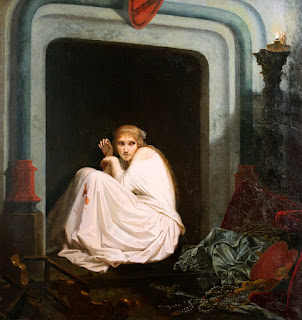
Folie de la fiancĂ©e de Lammermoor, Ă‰mile Signol, 1850. 

The darkness of the text and its imperialist perspective notwithstanding, the story somehow still manages to include absolutely brilliant comical moments, most accessible to me in the clash between English and Italian cultures. There is one scene in particular, where three English travellers in Italy go to the opera, that perfectly resemble real exchanges I have witnessed in my travels. His depiction brought particularly to mind a visit to the Arena di Verona in 1999 to see Aida, where the large contingency of Germans in the audience took exception to the more raucous behavior of the Italian attendees (the latter were adept at perfectly ignoring the former). In the book, the performance is Lucia di Lammermore. I've always wanted to see this, as The Bride of Lammermoor, upon which it is based, is my favorite Sir Walter Scott novel (in keeping with my well-established penchant for books about insanity). Perhaps that contributes to my delight in this moment:

Harriet, meanwhile, had been coughing ominously at the drop-scene, which presently rose on the grounds of Ravenswood, and the chorus of Scotch retainers burst into cry. The audience accompanied with tappings and drummings, swaying in the melody like corn in the wind. Harriet, though she did not care for music, knew how to listen to it. She uttered an acid “Shish!”

“Shut it,” whispered her brother.

“We must make a stand from the beginning. They’re talking.”

“It is tiresome,” murmured Miss Abbott; “but perhaps it isn’t for us to interfere.”

Harriet shook her head and shished again. The people were quiet, not because it is wrong to talk during a chorus, but because it is natural to be civil to a visitor. For a little time she kept the whole house in order, and could smile at her brother complacently.

Her success annoyed him. He had grasped the principle of opera in Italy—it aims not at illusion but at entertainment—and he did not want this great evening-party to turn into a prayer-meeting. But soon the boxes began to fill, and Harriet’s power was over. Families greeted each other across the auditorium. People in the pit hailed their brothers and sons in the chorus, and told them how well they were singing. When Lucia appeared by the fountain there was loud applause, and cries of “Welcome to Monteriano!”

One can almost feel sorry for Harriet (but not really).

These were the literary musings that entertained me while on holiday. I wish I had been able to read more. We are supposed to go to Florence this spring ... A Room with a View might prove irresistible in its temptations.

I had better hurry up and find those modern essays on Forster. Any suggestions?


Monday, January 31, 2022

Random Reflections on the Bigg-Wither's Affair

I must not allow this blog to fall back into neglect. It will not do. I cannot have struggled in vein to bring it back to some semblance of life. The thought is intolerable.

How often I imagine how very different Austen's life (and, subsequently, my own) would have been if she had maintained her very short engagement to Harris Bigg-Wither. Could she have found a way to maintain a household and family and still write her masterpieces? It seems very doubtful, especially when I can't seem to find the time to write with only two children and all the modern appliances, to say nothing of the godsend that is takeout/delivery to the modern parent in a pinch. Running a household in the early 19th century was so enormously more complicated (though at least the Regency homemaker was relieved the burden of calculating their carbon footprint). I don't see how Jane could have done it, even in a comfortable and well-staffed house such as Manydown Park must have been.

I am immensely grateful that she chose not to marry, though it must have been an awful decision to make. I am also relieved to know that my neglected writing is not so detrimental to literary culture. Such genius is a burden I'm rather happy not to bear.

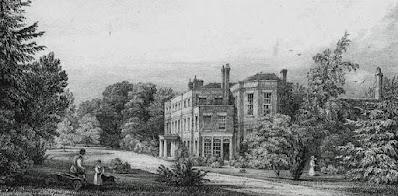
Manydown Park, 1833
Was it her writing that influenced Austen's rejection of Mr. Bigg-Wither? Or was it romantic notions? Or something else? We will never know, but the thing I feel fairly confident asserting is that when Jane and Cassandra landed unexpectedly at the Stevenson rectory and poured the entire adventure into James Austen's ears is that they were very likely told off. Think Sir Thomas when Fanny rejects Mr. Crawford:

And I should have been very much surprised had either of my daughters, on receiving a proposal of marriage at any time which might carry with it only half the eligibility of this, immediately and peremptorily, and without paying my opinion or my regard the compliment of any consultation, put a decided negative on it. I should have been much surprised and much hurt by such a proceeding. I should have thought it a gross violation of duty and respect. You are not to be judged by the same rule. You do not owe me the duty of a child. - Sir Thomas Bertram, Mansfield Park
Such a decision would, according to the morality of the day, be seen as incredibly selfish, hindering the entire family's prospects. More parents of the era would relate to Mrs. Bennet's opinion of Elizabeth's rejection of Mr. Collins, ridiculous as she is, than that of Mr. Bennet. The brother of her friends and heir to his estate, located in Austen's native neighbourhood, amongst her closest friends and relations: James, who always struck me as the family curmudgeon, must have given her an earful.
She is a very headstrong foolish girl, and does not know her own interest; but I will make her know it. - Mrs. Bennet, Pride and Prejudice

These are the thoughts that occupy me as I continue to try and get life back into something like a routine rhythm. There is always solace and useful distraction to be found in Jane. What would we do without her?

Wednesday, January 12, 2022

My COVID-19 Saga

Happy New Year! When I last wrote, I was full of hope for 2022. Unfortunately, the year got off to a very disappointing start, as my family succumbed to COVID. I almost wrote finally succumbed. There was a definite sense of inevitability as it dawned on me, through heavy brain fog, what it was that ailed me. Today is the family's first day out of isolation, and I'm trying to get my head back on straight and process what happened to us. Forgive me as I completely abandon Austen for the moment and use this forum as a place to record and reflect on the experience.

It's really difficult to know where to begin.

My husband and I are double vaccinated. We had appointments to get boosters (now rescheduled for next week), but because of the Swiss system of eligibility, we could not have legally gotten them within this country in time to avoid infection. My brother-in-law, who lives in Germany and received his booster just about a week before we got sick, was with us over Christmas, while we were all infected, and repeatedly tested negative.

First my son got sick, and on his birthday, poor little guy, but it did not appear to be COVID. He had a sudden fever which went down quickly with medication and dissipated completely over the next 24 hours. No other symptoms. I wrote this off as another of the many common, mysterious childhood ailments that circulate in nursery schools. Fortunately, everyone was home for the holidays (when everything, including most test centers, are closed here) and not socializing outside the house, anyway. Then my daughter complained about headache, ear ache, and throat ache, but only when she was bored. As she danced about the house the rest of the time, I did not worry. She has a history of anxiety headaches, and she was starting a new school on January 3rd. This seemed the more reasonable explanation for her discomfort. Then, suddenly, my ears started to ache. I thought it could be sinus pressure, but it felt different. More like a dull ache in the ear canal itself than the far too customary throbbing from my sinus cavities. John said he felt off, maybe sick. Alarms were starting to knell in my head, but it was now his birthday, and he seemed to be rallying, so we proceeded with our cooking and feasting plans. Shortly before dinner, I said I needed a quick nap. I pretty much slept for the next 48 hrs. Fortunately, John was not as debilitated as me. He and the kids managed to enjoy a cozy New Year at home sans Mama, and for that I am grateful.

I do not know what variant we had because of the difficulty accessing full testing options over the holidays, but I can tell you what it felt like. It was certainly what is referred to as mild COVID. I had no fever or trouble breathing. It did not feel like the common cold or rhinovirus, to which I'm susceptible. The brain fog, as mentioned, was prevalent, but it wasn't only effecting the clarity of my thoughts. My entire head felt kind of vacuous: a strange sense of emptiness. "Fog" is an inadequate descriptive. The lack of mucous left my nose feeling voided, and the sensation seemed to penetrate outward until it pressed against my skull, causing a dull but constant pain. I had never felt anything like it before, and because of the novelty of the sensation, I pretty much knew exactly what I had before the test confirmed it. After I woke up and rejoined the world, I continued to have short waves of sickness over the next several days, despite otherwise feeling pretty normal. By the end of the week, this had passed, but then, seemingly suddenly, both John and I lost our sense of taste and smell.

This is terribly disconcerting.

I am the buyer and preparer of my children's food. How can I pick out fruit, when I can't even smell sour milk? I also can't tell if they need a bath, or smell smoke from the fire.

The good news is that we seem to be slowly regaining our sense of taste. I can now vaguely taste cheddar cheese (my favorite), when I couldn't a week ago. I can tell if I brushed my teeth or not. All this is a strong indicator that we will recover. I cling to that thought and look forward to the day that I can bring a vast new appreciation to every thing I taste and smell. May it be soon! We're a foodie family. I don't know what we do without that joy in our lives.

Other good news: though my daughter was horribly disappointed to not be able to begin school in person on the 3rd, we found the new school's home learning plan massively superior to what we had before. She was very happy and surprisingly calm when I dropped her off this morning. This afternoon, she takes her first ever school bus ride (they are not common here). She's so excited, and so I am. I can't wait to hear all about it.

So that's the bulk of my saga. To cope with isolation, we went ahead and celebrated Christmas again last weekend. We made gifts for each other and cooked up another feast (which the kids tell us tasted good). We also watched the entire Harry Potter film collection while running about the place on broomsticks fashioned out of old wrapping paper rolls. We had fun, but thank goodness it's over.

Now to start picking up the dropped pieces of my life. I should probably start by taking down the Christmas tree. It's dried to a crisp, and I can't smell smoke.

May 2022 fulfil all my best hopes for it, despite this inauspicious start. I wish you all health, happiness, and Austen galore. Next week ...