Showing posts with label Art. Show all posts

Friday, October 2, 2020

Harping on Harps

Lady with a Harp: Eliza Ridgely, 1818.
Thomas Sully, oil on canvas.
National Gallery of Art.

Inspired by an article in Persuasions, I have been dwelling on the role the harp plays in Austen’s novels. The essay points to the instrument as an indicator of social status, as only the quite wealthy had both the leisure to learn and the ability to afford one. I was further struck by how Austen, with remarkably playful precision, utilises this stature accorded to the harp to highlight the inequalities of Regency society. It’s very scarcity in the novels marks it as elite. Only a handful of characters can play: Georgiana Darcy, Mary Crawford, at least one of the Misses Musgroves, and a Miss Beaufort in the unfinished novel Sanditon. Mary Crawford is the only one whose performance is part of the plot, and her knowledge of the harp illustrates the vast gulf of difference that lays between Miss Crawford and Fanny Price in Mansfield Park, both socially and morally. The harp was at the cutting edge of fashion: the perfect accessory for the classical greek and roman silhouettes then in vogue. Mary, performing in a carefully draped empire gown, undoubtedly resembled one of the many fashion plates of the era featuring the harp. It was a rather sensual look, as the harp hugs the figure and accentuates bare arms, evoking images of loosely clad nymphs, muses, and sirens. As Austen notes, “A young woman, pretty, lively, with a harp as elegant as herself, and both placed near a window, cut down to the ground, and opening on a little lawn, surrounded by shrubs in the rich foliage of summer, was enough to catch any man’s heart.” Fanny, on the other hand, has never even heard a harp played, let alone thought about how to pose with one to advantage. She has spent almost her entire life in seclusion at Mansfield, while Mary epitomises urbane sophistication.

Costume Parisien, 1800.

In Sanditon, which Austen was working on until illness interfered in the last months of her life, the harp presents an appearance of affluence, and as every sharp reader of Austen knows, appearances can deceive. The story is set in a fictional seaside resort promoted by a local gentleman named Mr. Parker, who has heavily invested in making Sanditon “the favourite spot of all that are to be found along the coast of Sussex—the most favoured by nature, and promising to be the most chosen by man.” As he and his wife escort the story’s heroine to their home, where she is to spend her summer, the sound of a harp, along with other indicators, are pointed out as heralds of his venture’s success:

The original village contained little more than cottages; but the spirit of the day had been caught, as Mr. Parker observed with delight to Charlotte, and two or three of the best of them were smartened up with a white curtain and “Lodgings to let,” and farther on, in the little green court of an old farm house, two females in elegant white were actually to be seen with their books and camp stools; and in turning the corner of the baker’s shop, the sound of a harp might be heard through the upper casement.

Such sights and sounds were highly blissful to Mr. Parker. Not that he had any personal concern in the success of the village itself; for considering it as too remote from the beach, he had done nothing there; but it was a most valuable proof of the increasing fashion of the place altogether. If the village could attract, the hill might be nearly full. He anticipated an amazing season.

La Belle Assemblée, 1809.
Amongst those (not quite) flocking to Sanditon are the Misses Beauforts and Miss Lambe, three young ladies in the charge of Mrs. Griffiths, “a very well-behaved, genteel kind of woman, who supported herself by receiving such great girls and young ladies as wanted either masters for finishing their education or a home for beginning their displays.” The following description of the Misses Beauforts is magnificently derisive, much in the manner of Austen’s earliest work:

The other girls, two Miss Beauforts, were just such young ladies as may be met with, in at least one family out of three, throughout the kingdom. They had tolerable complections, showy figures, an upright decided carriage and an assured look; they were very accomplished and very ignorant, their time being divided between such pursuits as might attract admiration, and those labours and expedients of dexterous ingenuity by which they could dress in a style much beyond what they ought to have afforded; they were some of the first in every change of fashion. And the object of all was to captivate some man of much better fortune than their own.

Mrs. Griffiths had preferred a small, retired place like Sanditon on Miss Lambe’s account; and the Miss Beauforts, though naturally preferring anything to smallness and retirement, having in the course of the spring been involved in the inevitable expense of six new dresses each for a three-days visit, were constrained to be satisfied with Sanditon also till their circumstances were retrieved. There, with the hire of a harp for one and the purchase of some drawing paper for the other, and all the finery they could already command, they meant to be very economical, very elegant and very secluded; with the hope, on Miss Beaufort’s side, of praise and celebrity from all who walked within the sound of her instrument, and on Miss Letitia’s, of curiosity and rapture in all who came near her while she sketched; and to both, the consolation of meaning to be the most stylish girls in the place. The particular introduction of Mrs. Griffiths to Miss Diana Parker secured them immediately an acquaintance with the Trafalgar House family and with the Denhams; and the Miss Beauforts were soon satisfied with “the circle in which they moved in Sanditon,” to use a proper phrase, for everybody must now “move in a circle” to the prevalence of which rotatory motion is perhaps to be attributed the giddiness and false steps of many.

The Sirens and Ulysses, 1837.
William Etty, Oil on Canvas.
Manchester City Galleries

I could easily write an entire post digging through those two paragraphs alone, as they contain so much social commentary, but let’s just focus on the harp’s role. Its hire (as well as the purchased drawing-paper) was no cheap feat, undermining the professed economy just as much as the over-abundant wardrobes. Even more than Miss Crawford sitting in her window frame, Miss Beaufort is literally playing the siren, using her music to lure (preferably wealthy) gentlemen to her. Like so many of the “feminine accomplishments” we see in Austen, the harp is used as bait to catch a wealthy husband. Their performances on the pianoforte help mark Marianne Dashwood, Elizabeth Bennet, and Jane Fairfax as worthy of social elevation, why should the more alluring harp not function similarly for Miss Beaufort? All I can say is that it didn’t end up working out so well for Miss Crawford. Perhaps the staid pianoforte makes a better impression, after all.

Mansfield Park, Chapter Seven.
C.E. Brock, watercolor.
Mollands.net.

Emma Woodhouse says to Mr. Knightley when he arrives at a party in a carriage, “‘This is coming as you should do,’ said she; ‘like a gentleman,'” and chides him when he fails to do so. She would not need to so admonish Austen’s harps. When they ride, they ride in style, even supplanting Louisa Musgrove’s place in her family carriage. Louisa’s willingness to walk the short distance to Uppercross cottage might seem merely accommodating to a modern reader, but think of how offended Mary Musgrove would be were such a suggestion made to her. For those concerned with precedence, as most at the time were, the harp riding in Louisa’s stead is a very real insult to her dignity. Miss Crawford’s harp is afforded even greater status, for it is not forced to crowd into a family coach: “Henry, who is good-nature itself, has offered to fetch it in his barouche. Will it not be honourably conveyed?” The method of transport may be honorable, but for all its glamorous trappings (or maybe because of them), Austen seems uncertain of the harp’s respectability. All the women in her novels who are associated with the harp are morally problematic except for Miss Darcy (unless you hold Wickham against her), but much more attention is paid to her ability on the piano. That she plays is only ever mentioned by Miss Bingley, just before she rattles off her list of qualifications to be considered an accomplished lady. Of our other harpists, it can be said that Miss Beaufort is vapid and grasping, the Misses Musgroves are giddy to the point of imprudence, and Miss Crawford possesses, to use Edmund Bertram’s words, “a dash of evil.” The very sophistication that makes Mary and her brother so appealing is also what taints their characters, and Fanny’s insular purity triumphs over them both.

There you have the gist of my thoughts, or at least those coherent enough to share. Please enjoy some music from the 2005 version of Pride and Prejudice, played on the harp, of course, as I bid you goodbye. It’s really very lovely and not all wicked and debauched. Sorry.


Tuesday, August 15, 2017

More Agreeably Engaged, Conversation with K. Wiedemann and Giveaway (Darcy in Wonderland Blog Tour)

Today's stop on the blog tour is at the fabulous blog More Agreeably Engaged, home of Janet Taylor: Austenesque artist extraordinaire.  It only seemed appropriate when visiting Janet to use the opportunity to showcase my sister's illustrations for Darcy in Wonderland. Join us for an international interview and a conversation between Katy Wiedemann and myself about the process of creating the images.

https://moreagreeablyengaged.blogspot.ch/2017/08/ever-since-alexa-adams-mentioned-idea.html

Tuesday, December 6, 2016

How far have we come? Princess Charlotte's death in childbirth

Princess Charlotte Augusta of Wales
by George Dawe, oil on canvas, 1817
I'm not going to devote the time this topic deserves. That's more of a promise to myself than anything else, but I have been inspired to speak on the subject, and I will do so, even if I do not go as deep as the topic warrants.

I spoke not long ago of Princess Charlotte of Wales when I was sharing my adventures in London at the National Portrait Gallery (read the post here). She died after an excruciating breach labor to a still-born son which use of forceps could have prevented, but such intervention was against the philosophy ascribed to by her attending physician. This national tragedy sparked a new interest in birthing practices amongst members of the medical establishment: an entirely male body. Prior to this time, many doctors were content to leave the mysteries of childbirth in the capable (if often dirty) hands of the midwives. The effect of childbirth becoming such an intense focus of study had many positive effects but also many drawbacks, and we remain to this day subject to the inadequacies of a field of study conducted almost entirely by those who have no first hand knowledge of the experience.

Two articles in the news lately grabbed my attention. The first's headline is one that I'm sure ensnared many. 100 Women in 2016: Researching the female discusses the lack of knowledge we have in mapping the nerve endings in female genitalia as opposed to the swath of information available on the male. This dearth of knowledge leads many in gynecology and obstetrics to attribute responsibility for sexual dysfunction on the patient, as they do not understand the medical cause. The second article, Cesarean births "affecting human evolution", regards a study conducted in Austria demonstrating an increase in the number of women suffering from fetopelvic disproportion, or FPD, and attributing it to medical intervention's effect on the evolution of humanity. Basically, because cesarean births have enabled women who (like Princess Charlotte) may not otherwise have survived and delivered healthy offspring to do so, a genetic predisposition for a narrow pelvis is being passed down from one generation to the next, increasing the number of women who aren't able to deliver vaginally because the baby's head is too large to pass through the mother's birth canal. The result is the cervix doesn't dilate all the way, and labor fails to progress naturally.

This next paragraph is somewhat gruesome. Be warned.

Princess Charlotte went into labor at 42 weeks and 3 days on the evening of November 3, 1817. Having followed her prescribed diet, called a "lowering" treatment, she was weak due to inadequate nourishment and bloodletting. Mild contractions came at 8 to 10 minute intervals. Her cervix was considered to be a "half penny dilated," whatever that means (I could find out, but I'm not taking the time to do so). Around 3 am the princess had a violent vomiting spell, and important state personages were called into attendance. At 8 o'clock in the morning on the 4th she was only 3 centimeters dilated, and the labor continued to progress slowly. The following day at noon, after the presence of meconium was detected, doctors began to fear for the cild's life. A 9 pound, still-born boy was not delivered vaginally until 9 pm on the 5th of November. Charlotte had been in labor for 44 hours. Thirty minutes later she began hemorrhaging. The doctors were able to extract the placenta, and for a time all seemed relatively well, yet by the 6th she was dead, having experienced a series of severe spasms (follow the link for a detailed account of Charlotte's labor and death: http://www.innominatesociety.com/Articles/The%20Death%20of%20Princess%20Charlotte%20of%20Wales.html).

This is in many ways so similar to what happened to me when I gave birth to my daughter, yet with all the benefits of modern medicine that a 19th century princess could ever imagine. My daughter wasn't breach, but she was facing backwards, so all my labor pains were in my back and very intense. I could have blessed the anesthesiologist when I received the epidural. From then on my pains were not acute, but the labor didn't really advance. I had discussed with my doctor upon first being pregnant my doubts about being able to deliver vaginally, and she must have recalled my warnings, because after only one round of pushing at 8 centimeters with no progress she looked at me and said, "How wed are you to the idea of vaginal birth, because this is going to take a very long time. A mere hour later I had my daughter, but I could not hold her for several because of hemorrhaging. Sound a bit like Charlotte?

The reason I doubted my ability to give birth naturally was many fold. First, I was so fortunate as to have a gynecologist once who thankfully bothered to mention that I had unusually narrow cervix. Second, my husband and I were both the products of mothers who only had cesareans. Both are small women who delivered large babies. Third, my husband has one of the biggest heads I've ever seen. I mean, he can hardly buy a hat. I considered the matter and concluded it was quite likely I would not have a natural childbirth. Every medical expert I spoke with fervently disagreed.

I am now thinking of having another child. My hope is that this new research will allow me to point out a body of evidence to my new Swiss docs that helps them take my concerns about a VBAC seriously. My fear is that it will increase an already strong cultural reluctance towards assisted births of all sorts. I'm not particularly concerned about receiving proper medical attention if I need it, but I would rather avoid the rigamarole of waiting for the doctor to see the evidence before his or her eyes that I have been trying to explain for months and just get the whole ordeal over and done. First world problems, I suppose, but they take up a great deal of my attention.

So these are my thoughts on this sunny Tuesday morning. Doctors need to be less satisfied with their breadth of knowledge and start filling in the massive holes left by centuries of male-dominated medicine. In the meantime, please listen to your patients. Particularly when it comes to the female body, we are each so unique that it is impossible to boil us down into neat categories and distinct experiences, no matter how hard pregnancy manuals might try. It's disgraceful I should be able to compare the birthing practices of two hundred years ago to those of today and find doctors still subject to the same prejudices.

Wednesday, October 12, 2016

Horatio Nelson at the NPG and in Edinburgh

by Lemuel Francis Abbott, oil on canvas, 1797
I am not hugely enamored with military history, but one cannot study Jane Austen's era without knowing something of Nelson. For better or worse, my early impressions of the man were defined by the 1941 film That Hamilton Woman (it's amazing how many characters, both real and fictional, were first introduced to me as Laurence Olivier). Those of us who don't find military history fascinating sometimes cling to scandalous tidbits like Nelson's affair with Emma Hamilton, as they are far more engaging to our brains than battle maneuvers. So it was with some chagrin that I visited The Nelson Monument on top of Calton Hill only to discover the small but highly informative museum exhibit dedicated to him there made not a single mention of his notorious mistress. For my five pounds, I would have liked to have had that small bone tossed my way. Of course, I was paying to climb the tower and enjoy the view, which I would gladly do again.

I suppose the legitimate Nelson enthusiast must get rather bored of we dilettantes who want to delve again and again into the details of his great romance. I understand that his military career is legendary and of far greater lasting significance than the details of his love life. Yet when presenting the image of a man in his entirety - when seeking to understand his character and motivations - is not such information essential? Behold his portrait on display at the National Portrait Gallery in London: this is not the image of a glorified military emblem (as we saw George IV portray himself in the same room), but a surprisingly gentle and unassuming looking man, not formidable in the least despite the proudly display of his Star and Ribbon of the Bath and Naval Gold Medal. This portrait is based on one from a previous sitting for the same artist, though it was also taken from life, and it was commissioned for Lady Nelson. How I wished there were portraits of both she and Lady Hamilton nearby! Perhaps such a display would be a bit sensationalist, especially in a room of the gallery dedicated George IV, but I would have reveled in it, nonetheless. I find this portrait fascinating in its backstory. There is some madness in this tale, and that always sparks my imagination. This is from the NPG website:
Although Nelson only sat to him twice, Abbott subsequently copied the picture over forty times. The copies gradually declined in quality as the artist became mentally ill but this was no bar to their popularity. Many were purchased by Nelson's naval colleagues, his family and friends.  
In July 1798, Nelson's wife wrote to him: 'My dearest Husband - I am now writing opposite to your portrait, the likeness is great. I am well-satisfied with Abbott… it is my companion, my sincere friend in your absence…'.
Nelson supposedly began his affair with Lady Hamilton that September, so there's your scandal. Revel with me.

Please enjoy the views from the top of the monument. It was incredibly windy up there but totally worth the climb. One gets the feeling of being an admiral on his ship, looking out into the endless distance.

https://creativecommons.org/licenses/by-nc-nd/3.0/legalcode

The Nelson Monument, Calton Hill, Edinburgh

View of Hollyrood Castle from top of Nelson Monument

View of the rest of Calton Hill from Nelson Monument, including
the National Monument of Scotland and the City Observatory.

View of Arthur's Seat from Nelson Monument

View of Calton Hill, Edinburgh New Town, and the Firth of
Forth, estuary to the North Sea, from Nelson Monument.

Wednesday, September 28, 2016

The Prince Regent and Crew: Room 17 of the National Portrait Gallery, London

George IV doesn't get a lot of credit. Quite frankly, he's not very deserving of it. However, he did set the tone for the final years in which Austen lived, and though she spent most of her life under his father's rule, it is the Regency period with which we associate her. His best legacy is his patronage of the arts, and as an early admirer of Austen "suggested" she dedicate Emma to him. George IV might have been a ghastly leader, but he and his times maintain a hold on the collective imagination, and while I was exploring the National Portrait Gallery in London earlier this month I took particular interest in portraits of him, his contemporaries, and his associates. Here is a quick tour of Room 17 of the gallery, dedicated to George IV's regency and reign (1811-1830).

by Richard Cosway
watercolor on ivory
1792
 
by Richard Cosway
watercolor on ivory
circa 1780-1782
There are no less than four portraits of George IV in this room. I think that might be the most I saw of anyone in the entire museum. The two oldest are miniatures on display in a special case and date from the late 18th century. The first image portrays a younger, carefree prince, bright with promise of future mischief. He is about 20 years old, and it has been speculated that the miniature was commissioned for then-mistress Perdita Robinson. The second, in which he wears masquerade garb, was painted ten years later and is definitely a love token, as it is set in a locket with a a plait of hair on the back. The recipient might have been Maria Fitzherbert, the woman he illegally married in 1785, or another mistress. He officially parted with Mrs. Fitzherbert two years later (though they would later reconcile), that he might marry his cousin, Caroline of Brunswick, the following year. Desperately in debt, his father promised to bail him out if he went through with the marriage to a woman whom he had never met and came to despise.

Maria Anne Fitzherbert
by Sir Joshua Reynolds
oil on canvass, circa 1788

Caroline Amelia Elizabeth of Brunswick
by Sir Thomas Lawrence
oil on canvas, 1804
George IV and his legitimate wife had one child, Charlotte Augusta of Wales, within a year of their marriage before separating. Princess Charlotte, unlike her parents, had the sympathy of the people, and when she died after days of agonizing childbirth at the age of 21 a massive public mourning was observed.

Princess Charlotte Augusta of Wales
by George Dawe, oil on canvas, 1817

by Sir Thomas Lawrenceoil on canvas, circa 1814
This flattering but unfinished portrait by Sir Thomas Lawrence was originally intended for use on a medal that was never struck. Lawrence was forced to defend this unbelievable likeness. Three years into his regency at the time it was painted, George IV had already reached his famously large proportions, years of decadence taking their toll. Still, it's a gorgeous painting. I have a thing for unfinished portraits.

after Sir Thomas Lawrence, oil on canvas, 1815

Above find a work completed by Lawrence the following year. Again, it's very flattering (the Regent was well into his 50s), but I suppose that's what you have to do as portraitist to a monarch. I think this is how we often imagine George IV, in his elaborate military regalia. The Regency years saw Napoleons final defeat, but not because George IV was some sort of an awesome military leader, as portrayed in this portrait. He did, however, have a highly capable general and politician in Arthur Wellesley, 1st Duke of Wellington.


Arthur Wellesley, 1st Duke of Wellington
by William Salter, 
oil on canvas, 1839
George III died in 1820, and the following year his son was finally coronated. Before he would ascend the throw, George IV attempted in vain to have his marriage to Queen Caroline annulled. Having been abroad for years, she hurriedly returned to England after George III's death and was greeted by exultant crowds. The matter was debated in the House of Lords, the painting below depicting the sixth day of the proceedings. When she was acquitted of adultery (of which she was most certainly guilty), George IV banned her from the coronation, on which day she fell ill. She died a few weeks later, claiming to have been poisoned.

The Trial of Queen Caroline 1820 by Sir George Hayter, oil on canvas, 1820-1823
Also displayed in Room 17 are portraits of George IV's brothers, busts of artists and politicians of the day, and a portrait of Horatio Nelson, whom I will address another day. I conclude with thoughts on why a tumultuous time period such as the Regency should have such romantic appeal to modern audiences. How much did George IV reflect and sculpt the times in which he lived? Is it the very chaos of his era that enthralls us? I could dwell on such questions forever, and this room of the gallery is the perfect place for such contemplations.

Tuesday, September 20, 2016

Jane Austen's Portrait

I'm home! I had a fabulous time with family in Scotland then on my own in Bath at the Jane Austen Festival. I learned so much, and my current intention is to reinvigorate my blog by sharing my adventure with you. What better place to start than with the lady who made it all happen?

by Cassandra Austen, pencil and watercolor, circa 1810

I flew into London the day before the festival began and spent the night there, so I might have time to visit the National Portrait Gallery. I had missed this museum on my two previous visits because no one else in my traveling party was particularly interested. Other sights always took priority. As it turns out, it was a very good thing for me to go alone, because it allowed me to get lost in the collection for three, undisrupted hours. It was fabulous! Unsurprisingly, I was particularly excited by the many portraits of writers whose works have shaped my life and mind. I am putting together a virtual "scribblers tour" of the gallery for my next Austen Authors post (I'll crosspost here), but I want to use this forum to take a more in depth look at Jane alone.


by James Andrews, watercolor, 1869
published by Richard Bentley, stipple engraving, 1870

Let's be clear up front: the portrait of Jane Austen by Cassandra Austen is easily the most unsatisfying likenesses displayed in the entire gallery. It's really awful, and that is precisely what makes it so intriguing. As the plaque inserted beneath the glass box which contains the portrait so accurately states: "Few English novelists have commanded such popular affection and critical respect as Jane Austen." And this is the best we can do for her portrait? For over a century, artists have used this sketch as the premise for more "satisfying" renditions of Austen. It is this legacy which helps authenticate the portrait: James Edward Austen-Leigh used it as the basis for the watercolor he commissioned in 1869 for use as the frontispiece to his biography, A Memoir of Jane Austen. Painted by James Andrews, it is his watercolor from which the varied engravings of her image are derived. However, there is still dispute over the portraits authenticity. As Claudia Johnson notes in Jane Austen's Cults and Cultures, there is no recorded mention of Cassandra's portrait prior to 1869. The NPG's website states:
This frank sketch by her sister and closest confidante Cassandra is the only reasonably certain portrait from life. Even so, Jane's relatives were not entirely convinced by it: 'there is a look which I recognise as hers', her niece wrote, 'though the general resemblance is not strong, yet as it represents a pleasing countenance it is so far a truth.'
So is this Jane? If so, she appears almost surly in it, as if she can little spare the patience to sit for her sister. Austen-Leigh's biography, which he wrote was conceived "in a spirit of censorship as well as communication," clearly tried to remold his literary aunt into something acceptable to the family's Victorian sensibilities. He gave the public an image of a demure spinster, which does not mesh well with the acerbic nature of the novelist's voice. For this reason I much prefer Cassandra's drawing, even with all its deficiencies, than the prettied up version. I can more easily imagine Jane as an unwilling sitter than a wallflower.  


by Ozias Humphry, oil on canvas, 1788 

There is another portrait: one that fulfills all the expectations that Cassandra sketch so sadly disappoints. The Rice Portrait is the subject of hot debate. I admit: I am biased in its favor, and not just because it would be absolutely glorious were it her! First there is the fact the National Portrait Gallery, in its early days, attempted to acquire the portrait, at the time describing it as a portrait of Austen. It was only after the purchase fell through that the gallery cast dispersions on its authenticity. Next is the fact that while the portrait was long believed to be the work of Johan Zoffany, high definition images of the portrait have recently revealed the signature of Ozias Humphry (who had a history of painting portraits of the Austen family) as well as a date: 1788. The date is important for a variety of reasons but primarily because scholars had previously argued that the portrait, based on the clothing, had to have been painted in the early 19th century, when Jane would have been too old to be the sitter. Elite art historians and scholars are still reluctant to validate the portrait, maybe because it would place such a priceless object in private hands? I watch the debate eagerly for resolution, but there seems to be none in near sight. For more information, please visit www.janeaustenriceportrait.com.


by Cassandra Austen, watercolor, 1804

The only image we have of Austen that is positively, indisputably her is only of her back. As beautiful as Cassandra's other portrait is homely, it is perhaps my favorite of them all. How appropriate that we cannot see her disputed face! The author remains enigmatic, which is just as it should be. After all, every reader of Jane Austen has their own Jane. We hear her narrative voice. She speaks to us with an intimacy few other writers capture. We each have our own vision of who she is, from proper gentlewoman to devilish wit. Perhaps if we were certain what she looked like, our imaginations would not be so free to view her in the guise we choose. 


(Note: I have not discussed the "Byrne Portrait" in this post as I have yet to hear anyone but Paula Byrne insist on it's authenticity. Still, it offer another interesting possibility. I suggest this article for the full details: http://www.jasna.org/persuasions/printed/number34/kaplan-d.pdf)

Friday, November 29, 2013

What I want for Christmas ...

... or Hanukkah. We celebrate both around here:

Handmade Emma Woodhouse Doll
http://www.etsy.com/listing/110267567/emma-dear-emma-jane-austen?ref=shop_home_active


I've wanted this SOOO much since I first saw it, nearly a year ago. Isn't she gorgeous? Unfortunately, my daughter wanted an Annie doll instead (sigh). Get yours at ViaJoy on Etsy!

Miniature Pride & Prejudice Pop-Up Book
http://www.greenchairpress.com/index.cgi?page=tag&sub=6&id=0202


If no kind soul takes pity on me and gives me this book, I will be buying it for my daughter as soon as she's old enough to know not to destroy it. The book measures only 3 x3 and is (necessarily) abridged. Buy a copy from Green Chair Press!


Fitzwilliam & Elizabeth 2014 Calendar
http://www.jt-originals.com/graphics.html


He he! I already have a copy, but I'm listing it anyway because it was like an early Christmas present from the artist herself, Janet B. Taylor, who is currently giving away a copy on her lovely blog, More Agreeably Engaged, so don't miss out on the opportunity to enter and win your own!

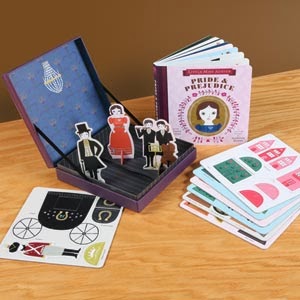
Little Miss Austen Pride & Prejudice Counting Primer and Play Set
http://www.amazon.com/BabyLit-Prejudice-Counting-Primer-Playset/dp/1423635159/?ref=pd_sim_b_17


I've been drooling over this since I first learned of it. I reviewed the board book sometime ago on a well-known blog (read it here), it was featured in my Reading Jane Austen to Children post, and the play set is just the sort of thing Eliza would enjoy right now. I admit to having already bought it for her as a Hanukkah present, so expect a review of some sort of another soon.

Pride & Prejudice Cookie Cutter Set
http://www.etsy.com/listing/161244460/pride-and-prejudice-cookie-cutter-set-3d?ref=pg_view_7


Love these! Best use of a 3D printer I have seen thus far. Buy them at Printmeneer on Etsy!

This list is subject to expansion and improvement, so stay tuned for more!

Monday, December 3, 2012

Austenesque Artwork

I call this painting Kitty Coughing, though it is not a title Masha Laurence, the artist, gave to it. Isn't it lovely? I was so fortunate, amidst all the joy that was Austen in August, to win a commissioned watercolor by Miss Laurence, the Antique Fashionista. It arrived during NaNoWriMo, which is why it took me so long to openly declare my thanks, where all may read it and share this beautiful addition to my art collection. I plan to hang it beside the only other Austenesque artwork I own, an image of Cassandra and Jane walking through the snow by Jane Odiwe (see it here, at the bottom of my review of Searching for Captain Wentworth).

As part of my prize, I got to choose the idea for the painting, and having just finished Second Glances, which is primarily about Kitty, I asked for a rendering of my favorite Kitty moment in Pride and Prejudice:
Mrs. Bennet deigned not to make any reply; but unable to contain herself, began scolding one of her daughters.

"Don't keep coughing so, Kitty, for heaven's sake! Have a little compassion on my nerves. You tear them to pieces."

"Kitty has no discretion in her coughs," said her father; "she times them ill."

"I do not cough for my own amusement," replied Kitty fretfully.
Having had frequent bouts of bronchitis as a teenager, I always sympathized with Kitty so much at this moment. It is easily argued that Austen was illustrating the weakness of her character by giving her such ridiculous words to say, but it is here when Kitty comes most alive for me. I love the perspective which Miss Laurence's chose for her portrayal. Mrs. Bennet is seated in green beside Mr. Bennet, hiding behind his paper. Lydia is standing, and Jane and Elizabeth are seated behind her (I like to think Elizabeth is in yellow). Kitty, of course is the lady holding her hand to her mouth. I really like the fact we can't see her face, as it gives me leave to think of her not as coughing, but laughing, as Elizabeth appears to be doing, at the ridiculousness of her family. It is also reminiscent of Cassandra's watercolor of Jane, in which we only see her back. I do miss Mary, but we must assume she is busy adding her share to the scene in the form of atrociously played music. I am absolutely delighted. Thank you, Masha, for doing such a beautiful job.

Other than Miss Laurence and Miss Odiwe, I know of only one other Austenesque artist, Dawn Schreiner, an illustrator who did a fabulous series of portraits featuring some of the actors who have interpreted Austen's heroes (see them here). Perhaps one day there will be a gallery featuring nothing but Austen inspired artwork, or even an entire Austenesque art movement, and my nascent collection will then be of great value. Regardless, these paintings inspired by Jane will be a continual source of joy to me and many others. Please keep painting ladies!

Wednesday, October 10, 2012

Isabella Ingram-Seymour-Conway, Marchioness of Hertford

I recently found a prettily framed print at a yard sale, obviously from the Regency Era and credited to Joshua Reynolds. For $20, I readily claimed it as my own. A quick Google search confirmed my good taste. The lady is one Isabella Ingram-Seymour-Conway, Marchioness of Hertford, and one of the Prince Regent's many mistresses. One must feel for her husband, Francis Seymour-Conway, who apparently relocated his family to Ireland in order to keep his wife away from Prince George. This seems to have been to little avail. Isabella was married at age sixteen, so I cannot find her terribly to blame if her eye wandered in later years. Their relationship was a long one, spanning from 1807 to 1819. As it seems she maintained relations with her husband throughout, I suppose he reconciled himself to sharing his wife. Most interesting is the influence she used with the Prince to align him with Tory politics. 

I still need to find a place on my wall for her, but once I have it will be my delight to suppose she and her royal paramour spent quiet evenings together reading the Austen novels he so admired. If anyone can furnish me with additional informat6ion about her, I am all ears.

Tuesday, March 22, 2011

The Rice Portrait Mystery

Jane Odiwe, artist and author of Lydia Bennet's Story, Willoughby's Return, and Mr. Darcy's Secret, has been at the forefront of unraveling a real life Austenesque mystery. The subject is the controversial "Rice Portrait" of Jane Austen, long believed by some to be the best (by far) portrait of the writer ever painted. The authenticity of the painting's subject has been a matter of dispute for generations. If it is Jane, it is the answer to many a fan's dreams, portraying her in all the youthful beauty we would like to attribute to the beloved author, but verification has never occurred. The argument for the portrait is compelling: the Rice family are direct descendants of Edward Austen Knight, Jane's wealthy brother, and the painting has been in the family since shortly after its execution. Despite familial testimonials, which have long held it to be an image of Jane, doubts about the painting have centered upon the lack of written mention of it from contemporary sources and questions about the period appropriateness of the sitter's dress. However, Ms. Odiwe has been presenting new and exciting evidence that makes the case that the portrait is indeed Jane and, perhaps even more thrilling to me, revealing a new painting that might very well be an even earlier image of the writer, portrayed with her family as a very young girl. I was ecstatic to be asked to share this information with you, and I urge everyone to follow Ms. Odiwe's blog (http://janeaustensequels.blogspot.com) as she reveals more and more pieces to this fascinating puzzle.


The first aspect in this new argument for authenticity is premised upon identifying Ozias Humphrey, portrait painter and miniaturist, as an established painter of the Austen family. Ms. Odiwe provides a brief biography of the artist in her first post in this series, which you can read here. Humphrey most certainly painted a portrait of Austen's great-uncle, Francis Austen of Sevenoaks, the man who paid for George Austen's (Jane's father) education and presented him with his second living at Deane, and Henry Austen is recorded commenting upon the painting. Furthermore, it is believed that Jane and Casandra were visiting Francis at the time when the Rice Portrait was commissioned. Humphrey's work can be identified by an unusual insignia he included in his paintings: an O with an H crossed through its middle. Ms. Odiwe's second post (read it here) focuses on identifying this mark in a series of Austen family portraits, starting with the verified image of Edward Austen Knight upon the occasion of his Grand Tour in 1788. First establishing a compelling argument that this portrait was not painted in Rome, as has been asserted, but in England, she goes on to identify Humphrey's signature hidden in the texture of the tree upon which Edward leans (an English oak). This brings us to the contentious portrait of Jane, also believed to be executed in 1788, in which she identifies not just one, but three potential monograms: in the tree, by her shoe, and in the locket around her neck.

Humphrey's establishment as a painter of the Austens becomes even more important in Ms. Odiwe's third post (read it here), in which she presents what she call a "Conversation Piece" and argues it is, in fact, an image of the Austens upon the occasion of Edward's adoption by the Knights. As intrigued as I was by the notion that new evidence has emerged confirming the identity of the young lady in the Rice Portrait, this painting sends cascades of chills down my spine. It is of a family, of a socioeconomic situation in keeping with the Austens', celebrating the eldest boy portrayed holding a bunch of grapes in triumph as his family looks on approvingly. If this is the Austens, then Jane is the young girl to Edward's left, flanked by Cassandra, and the boy on Edward's other side is either Henry or Francis (the latter is favored). James would be at school at the time, and Charles would still be with his wet nurse. The painting was part of a Godmersham Park (the Knight family home) estate sale in 1983 and is described in the accompanying Christie's catalogue, but its current whereabouts are unknown. Unfortunately, ths leaves us without a great image of the painting, or the ability for experts to examine it first hand, but Humphrey's signature OH can be spotted in many spots, (unfortunately, none of these are identifiable online). Even more exciting is the fact that Jane seems to be holding a horseshoe nail in her hand and pointing it at Edward. To return to his portrait, a similar (very small) horseshoe nail can be identified pointing towards him at his feet. Family lore has it that this symbol was significant to Edward, and Jane herself makes reference to it in one of her letters from 1813. I hope Ms. Odiwe will be revealing more information about the relevance of this symbol, but a bit of light research I have indulged in on my own reveals that horseshoe nails have long been used, like horseshoes themselves, to bring good luck and provide protection. There is also a religious affiliation, made in reference to the crucifixion.


While I feel like more information is still required (and most anxiously desired!) there is no doubt that Ms. Odiwe's recent posts are amongst the most fascinating it has ever been my pleasure to read. Let us all hope that we can, with brazen confidence, someday declare that the pretty young lady in the Rice Portrait is none other than a gorgeous Jane Austen. If we can add to the pleasure that of identifying an even younger Jane in the Conversation Piece, we will be happy Janeites indeed. Keep following this story on Ms. Odiwe's blog, and I will follow up as more details are revealed. Most importantly, if anyone has any information that helps authenticate either painting or regarding the current whereabouts of the family portrait, please get in contact with Ms. Odiwe via her blog, as the Rices are (understandably) very anxious to get to the bottom of these mysteries.        

Monday, March 7, 2011

Mr. Darcy's Secret by Jane Odiwe

Jane Odiwe, both writer and painter, is an extraordinarily talents lady. He newest book, Mr. Darcy's Secret, treats the reader to not only an apt display of her literary ability, but also of the aesthetic vision she draws upon in her paintings. As I read the novel, I experienced the same kind of wanderlust I am overcome by when I look at the pictures from her travels on her blog, janeaustensequels.blogspot.com, as she paints the scenery of Derbyshire and the Lake District in beautifully descriptive language. Indeed, the entire book is like a portrait of the Darcy's after their marriage - a glimpse into the joys and challenges they are likely to experience as they get to know each other and learn to communicate as husband and wife. Like all great paintings, it is not a perfectly pristine image, but one that challenges the mind and questions our assumptions.

I do not want to reveal any spoilers and so will have to tiptoe around the issue of just what Mr. Darcy's secret is, but what I will say is that its existence, and eventual revelation, pose just the kind of conflict to the newlywed couple that all romances must address: how much of your partner's past is it fair to inquire into, and how much can each individual safely share with the other. It is a strange reference, but I am reminded of a Tom Waits lyric: "I tell you all my secrets but I lie about my past." In my own marriage, I have found that complete honesty is the best foundation, and it is gratifying to see that when a similar policy is finally adopted by the Darcys, it has the effect of liberating both from long harbored burdens while strengthening their bond. I realize this seems rather intuitive to modern readers, we must remember that during the Regency it was the norm for men to lead lives that genteel women were almost entirely sheltered from, and the notion that a wife would intrude upon her husband's past (and present) associations was rather revolutionary.

The other plot line in the novel focuses on Georgiana and her quest for love. It comes as a shock to Elizabeth to discover that Darcy would like to arrange the kind of marriage of convenience he himself rejected for his little sister, and while she struggles to understand the protective instincts that drive him, Georgiana undergoes an internal battle, not unlike the one her brother overcomes in Pride and Prejudice, between fulfilling her perceived familial obligations and following her heart. Much of the book is written from Georgiana's perspective, and it is here that Ms. Odiwe finds the means of projecting her own artistic sensibilities through her characters. While Georgiana is usually presented as a master musician, we know, thanks to Miss Bingley's praise of her accomplishments, that she excels in many areas, so imagining her as a devoted artist is an easy leap for the reader to make. It is her love of art that draws her towards her romantic interest, a Mr. Thomas Butler, and it is through their attuned eyes that we see Ms. Odiwe's talent for capturing imagery, as in this scene:
Georgiana took the route along the lakeside, not the quickest, but the most beautiful. Everyday there was something new to see in the ever changing scene, whether it was of wildlife frequenting the water or the effects caused by weather transforming the mere into one of ethereal fantasy as the light and mists descended to play upon the surface. This morning, swathes of white vapour draped like bridal veils across the water rose in filmy clouds up to the blue heavens, transforming all she could see into shades of lilac and cerulean so that the fells and the water met one another in mutual harmony. She must remember to describe the scene to Tom, she thought, and could not resist pulling out her pocket sketchbook she had made for such a purpose. The sun was breaking through the clouds, fanning sunbeam fingers restlessly, caressing the surface of the mere like a pianist scaling up and down the keys. Everywhere was silence and for a moment Georgiana felt as if she were the only person in the world, and so small did she feel against the majesty of the mountains that made such a stunning backdrop, as well as the surrounding beauty of the landscape, that she was filled with a sense of the divine. Her pencil made rapid strokes. It was no good, she decided. It was impossible to do justice without using colour and she vowed to return later with her paints and brushes.
Interestingly, while engaging in such visual language, Ms. Odiwe mocks the literary pretensions of several characters, as Lady Catherine and Miss Bingley become devotees to the contemporary vogue for romantic poetic expression. Both these ladies journey to the Lakes to be inspired by the sublime, leading to several amusing moments in the text. The Wickhams too find themselves in the region, and all these disagreeables act precisely in the manner we expect, adding to the drama of the story. I think Ms. Odiwe particularly succeeds in developing Miss Bingley, who for a time almost becomes sympathetic, but just when I was prepared to feel sorry for her a burst of characteristic spite returns her back to her proper place in my estimation. It would have been very interesting if Ms. Odiwe fully developed the storyline surrounding Miss Bingley, even perhaps redeeming this despised lady in the manner of her previous novels, Lydia Bennet's Story and Willoughby's Return. Despite my enjoyment of this newest book, I prefer these previous efforts and hope that Ms. Odiwe will write more stories of the sort in the future, as they are amongst my very favorite of the many Austen sequels I have read.

I want to leave you with this wonderful image Ms. Odiwe painted, based upon Cassandra Austen's famous picture of Jane from behind. I love the notion of Austen turning around to give us that endlessly craved glimpse of her face, as it reminds me of the very purpose of reading and writing Austenesque literature. Jane gave us the framework within which to let our imaginations run wild, and we, her devoted fans, simple adore filling in the blacks and elaborating upon the clues provided. This is what Ms. Odiwe has accomplished so well in both this picture and in Mr. Darcy's Secret: extending and celebrating our delight in all things Austen.